

Selecting a corrosion-resistant valve requires more than choosing a stainless-steel grade or a fluoropolymer lining. The chemical composition of the process fluid, its concentration, operating temperature, pressure, flow conditions and the materials exposed to the medium all influence valve reliability. A body material that performs satisfactorily in one acid concentration can corrode rapidly under different operating conditions.
Identify the actual corrosive service
Record the main chemicals, concentration ranges, impurities, dissolved gases, suspended solids and cleaning agents present during normal operation and maintenance. Include both continuous and intermittent exposure. Concentration changes, shutdown conditions and unexpected dilution may create corrosion mechanisms that are not evident from the nominal process description.
Temperature affects chemical reaction rates and material resistance, while pressure and differential pressure influence the mechanical suitability of the valve and its lining. The selected valve must meet both corrosion-resistance requirements and the pressure-temperature limitations of the complete assembly.
Compare metallic wetted materials
Carbon steel, cast iron, stainless steel and higher-alloy materials respond differently to acids, chlorides and oxidizing media. Austenitic stainless steels such as 304, 316 and 316L should not be treated as universally acid resistant. Grades 316 and 316L are chromium-nickel-molybdenum stainless steels; the molybdenum addition can improve resistance to certain forms of localized corrosion. The lower carbon content of 316L is particularly relevant to resistance against sensitization after suitable welding processes.
Hydrochloric acid can attack common austenitic stainless steels even under conditions where those materials perform well in other chemicals. Sulfuric-acid corrosion depends strongly on concentration, temperature and flow velocity. Nitric acid is an oxidizing medium whose compatibility must be evaluated separately from non-oxidizing acids. Acetic-acid and chloride-containing services likewise require their own material assessment.
The actual casting or forging grade must be identified correctly. Cast CF8M should not be relabelled as a 316L casting. For chloride-rich environments, pitting, crevice corrosion and stress-corrosion cracking can be more important than the average uniform corrosion rate.
Understand fluoropolymer-lined valve options
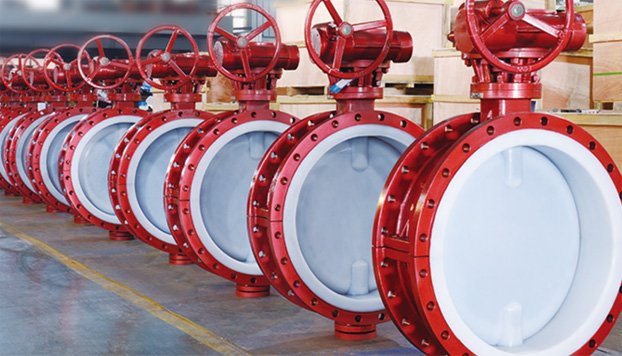
Fluoropolymer-lined valves separate the process medium from much of the metallic pressure shell through a chemically resistant barrier. PTFE (F4), FEP (F46) and PFA are different materials and must not be treated as interchangeable names. Their permissible temperatures, manufacturing methods, lining thicknesses, mechanical characteristics and chemical compatibility must be considered individually.
A lining does not automatically protect every wetted component. The disc or ball, stem area, seat, gasket surfaces and any exposed metal must also be included in the corrosion assessment. The pressure rating of the metallic shell alone is not the working limit of the lined valve; the complete valve construction must satisfy the operating pressure, temperature and differential pressure requirements.
Corrosion-resistant valve selection matrix
| Service concern | Material consideration | Selection check |
|---|---|---|
| Hydrochloric acid | Common stainless steels may suffer rapid attack | Confirm concentration, temperature and suitability of all wetted materials or lining |
| Sulfuric acid | Resistance changes significantly with concentration and temperature | Use chemical-specific corrosion data and evaluate flow conditions |
| Nitric acid | Oxidizing conditions alter material performance | Verify the grade against actual concentration and temperature |
| Chloride-rich water | Localized pitting and crevice corrosion may control selection | Evaluate chloride level, temperature and crevice locations |
| Mixed or changing chemicals | One material may not resist every phase of the duty | Check normal, cleaning, startup and shutdown exposure |
| Abrasive or particulate media | Mechanical wear may damage a corrosion barrier | Review velocity, solids, seat design and lining wear risk |
Choose the valve type and construction
After selecting suitable wetted materials, choose a valve type that meets the required function. Ball valves provide quarter-turn isolation in suitable clean-fluid services. Butterfly valves offer compact construction but keep a disc within the flow passage. Diaphragm and plug valves may offer alternative isolation arrangements where their construction and material compatibility suit the process.
Check the actual connection standard, bore, required tightness, allowable differential pressure, operating torque and actuator arrangement. A corrosion-compatible body and lining are not sufficient if the seat design, actuator or installation arrangement cannot meet the process requirements.
Information required before ordering
- Medium name, concentration range, impurities and cleaning chemicals
- Normal, minimum and maximum operating temperatures
- Design pressure, differential pressure and pressure transients
- Required valve type, size, connection and shut-off function
- Wetted body, disc or ball, stem, seat, gasket and lining materials
- Solids content, flow velocity and operating frequency
- Applicable project standards, inspection and documentation requirements
Explore related lined valves, ball valves and butterfly valves when comparing suitable valve constructions.
Frequently Asked Questions
What process information should I provide to select a corrosion-resistant valve?
Provide the chemical names, concentration ranges, impurities, cleaning agents, operating temperatures, design pressure and differential pressure. Also identify suspended solids, required valve function, size and connection. Material selection must cover every component exposed to the medium, not just the valve body.
How do I choose between PTFE, FEP and PFA lining?
Check each lining against the actual chemical, concentration and operating conditions. PTFE (F4), FEP (F46) and PFA are distinct materials with different chemical and mechanical properties, processing methods and operating limits. Do not substitute one solely because all three are fluoropolymers.
What pressure and temperature limits should I confirm before ordering a lined valve?
Confirm the limits of the complete lined valve, including the lining, seat, disc or ball and other wetted components, at the required differential pressure. The metal body rating alone does not establish the allowable working range of the assembled valve.