
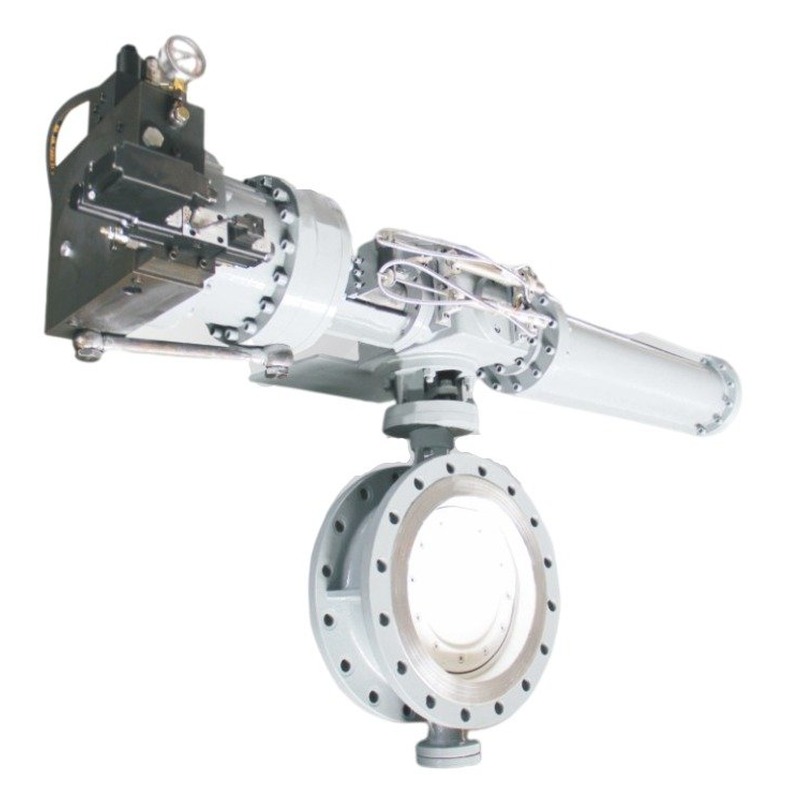

Fork Type Pneumatic Cut-Off Butterfly Valve
The fork type pneumatic cut-off butterfly valve is an emergency isolation valve designed for pipelines that must stop flow within a fraction of a second when a safety interlock or process trip signal is received. Manufactured by Trekre & Fouten Valve at our Wuxi factory, this flanged butterfly valve combines a triple-offset metal seated disc with a scotch-yoke (fork type) pneumatic actuator and spring-return cylinder arrangement. The actuator geometry converts linear piston force into high stem torque at the start of stroke, helping the disc break away from the metal seat quickly and reach the fully closed position in approximately 0.3 seconds on typical production sizes when air supply and piping are configured to the actuator nameplate.
Compared with standard double-acting rack-and-pinion pneumatic butterfly valves, the fork type cut-off configuration prioritizes rapid full-stroke closure over modulating control. Compared with resilient seated wafer butterfly valves, the triple-offset metal sealing path addresses higher temperature steam and gas service where elastomer seats would not remain stable. The valve is commonly specified on waste heat recovery lines, extraction steam systems, boiler feed headers and other circuits where a fast pneumatic shutoff supports turbine protection or process safety logic.
Fork Type Pneumatic Cut-Off Butterfly Valve Specifications
Structure and working principle
The valve body is a double-flange pattern with raised or flat faces per the purchase specification. The disc follows a triple-offset (triple eccentric) path: the shaft axis is offset from the disc centerline, the shaft is angled relative to the pipeline axis, and the disc seal cone is further offset so the disc contacts the seat only at the final closing degrees. This geometry reduces sliding friction between metal seat surfaces during most of the stroke and concentrates sealing load at closure.
The fork type pneumatic actuator mounts on an ISO 5211 top flange and uses a scotch-yoke mechanism to amplify torque at the beginning and end of disc travel. A single-acting spring-return cylinder stores energy in the return spring so the valve moves to the safe position when pilot air is vented. An air filter-regulator supplies clean, stable pressure to the pilot circuit. A pneumatic solenoid valve routes air to open or close ports according to the control system. Optional limit switch boxes report open and closed position to the DCS or safety PLC. End-of-stroke cushioning reduces mechanical impact when the disc reaches the seat at high speed.
Nominal size and pressure class
Standard production covers nominal diameters from DN100 to DN1200 (NPS 4 to 48) in common increments for power and process piping. Pressure ratings typically include PN16, PN25 and PN40; ANSI Class 150 and Class 300 flanged configurations are available when the project references ASME B16.5. Face-to-face dimensions follow manufacturer tables for triple-offset flanged butterfly valves or project-specific requirements. Confirm flange drilling, gasket type and bolt set before ordering companion flanges.
Body, disc and seat materials
Valve body options include cast carbon steel WCB for general industrial and power service, low-alloy steel for higher temperature steam duty, and stainless steel CF8 (304) or CF8M (316) for corrosive environments. The disc is stainless steel with surface treatment matched to the medium. The seat is metal—commonly stainless steel base with Stellite or equivalent hard facing on the sealing surface for wear resistance at high temperature. For ambient temperature gas or air service where project economics allow, a dual soft-core local sealing insert can be specified as an alternative seat configuration; confirm temperature limits before selecting soft sealing elements. Stem and internal fasteners use stainless steel grades suited to the operating medium.
Sealing form and leakage performance
Primary sealing relies on the triple-offset metal-to-metal contact between disc edge and seat ring at full closure. At high temperature, metal sealing maintains dimensional stability where resilient materials would degrade. Closure leakage is verified by seat test per the agreed project protocol and manufacturer test procedure; state the required leakage class or test medium in the purchase specification rather than assuming a universal rating across all sizes and pressure classes. Soft-core seat options, when selected for lower temperature duty, follow the same project-specific test requirements.
Pneumatic actuation and control options
The valve is operated by a fork type single-acting spring-return pneumatic actuator sized for breakaway torque at the specified supply pressure. Supply air should be filtered, dried and regulated according to the actuator nameplate, commonly in the 4–7 bar range unless otherwise stated. Double-acting actuators are not the default on this cut-off design because spring-return fail-safe action is the typical safety requirement. Emergency closure can also be achieved with an accumulator package when the plant air header cannot guarantee pressure during a trip event; both spring and accumulator solutions require engineering review of stored energy and reset procedure.
Control accessories include solenoid valves, air filter-regulators, quick exhaust fittings, limit switches and junction boxes for hazardous area classification when required. Modulating positioners are generally not fitted on emergency cut-off duty valves because the application focus is full open or full closed states within a short time window.
Applicable working conditions and industries
This fork type pneumatic cut-off butterfly valve is specified on extraction steam lines, waste heat boiler outlets, turbine bypass headers, fuel gas isolation trains, process safety interlock circuits and other systems where rapid pneumatic closure supports equipment protection. The triple-offset metal seat suits clean steam, hot gas and general process fluids within the material temperature limits. For slurry, high particulate or cavitation-prone service, consult Trekre & Fouten application staff on seat facing and disc options before finalizing the specification.
Standards, inspection and delivery
Design and inspection commonly reference API 609, MSS SP-68, EN 593 or GB/T 12238 depending on the project region. Each valve undergoes shell pressure test and seat closure check before shipment. Material certificates, dimensional reports, actuator stroke timing records and functional tests can be included in the QA dossier when requested. Valves are cleaned, flange-faced protected and packed for export from Wuxi. Trekre & Fouten Valve engineers can review your medium composition, temperature profile, required closure time and fail-safe direction to confirm body material, seat selection and actuator class.
Product parameters
| Valve type | Fork type pneumatic cut-off butterfly valve |
| Structure | Triple offset (triple eccentric), double flanged |
| Size range | DN100 – DN1200 (NPS 4 – 48) |
| Pressure rating | PN16, PN25, PN40; Class 150 / 300 (as specified) |
| Body material | WCB, alloy steel, CF8 (304), CF8M (316) |
| Disc / seat | Stainless steel disc; metal seat with hard facing; optional soft-core seat at ambient duty |
| Operation | Fork type scotch-yoke pneumatic actuator, single-acting spring-return |
| Closure time | Approximately 0.3 s on typical sizes (confirm per size and air supply) |
| Top flange | ISO 5211 actuator mounting |
| Temperature range | Per body and seat material selection; confirm for steam duty |
| Design standard | API 609, EN 593, MSS SP-68, GB/T 12238 (as agreed) |
| Test | Shell and seat test per project specification; leakage per agreed protocol |
Selection notes
Specify flange standard and pressure class, body and seat material, operating temperature and steam condition, required fail-safe direction (air to open / spring close or reverse), and the maximum acceptable closure time. State control voltage and area classification for solenoid and switch accessories. Confirm available plant air pressure during emergency events; specify accumulator backup if header pressure may drop during a trip. Allow clearance for actuator height and maintenance access to the solenoid and filter-regulator station.
Installation and maintenance guidance
Install the flanged valve with gaskets suited to the medium and flange class. Align piping to avoid stem side load. Mount the actuator within orientation limits on the nameplate. Connect air supply through a filter-regulator and verify spring-return closure with pilot air vented before putting the safety circuit live. Test the full emergency sequence with the control system during commissioning. Periodically exercise the valve through a controlled trip test per plant safety procedure. Inspect seat contact and actuator cushion settings if closure time drifts or impact noise increases. Replace stem packing when external leakage appears during thermal cycling.
Comparison with adjacent designs
Standard pneumatic rack-and-pinion flanged butterfly valves suit general on-off isolation where sub-second emergency closure is not required. Resilient seated lug or wafer pneumatic valves remain economical for water and HVAC but do not address high temperature metal sealing. Fully welded triple-offset valves address buried or high-integrity piping with a different body pattern. Electric actuators replace pneumatic drives when compressed air is unavailable, though electric stroke times are typically longer than fork type pneumatic cut-off packages. The fork type pneumatic cut-off butterfly valve fits safety-critical flanged lines where triple-offset metal sealing and rapid spring-assisted closure are both required.
This fork type pneumatic cut-off butterfly valve extends the Trekre & Fouten pneumatic butterfly valve range for plant owners who need fast emergency isolation on steam and process headers. Contact our sales team with flange details, medium data, fail-safe preference and required closure time for quotation and delivery schedule from our China valve manufacturing facility.