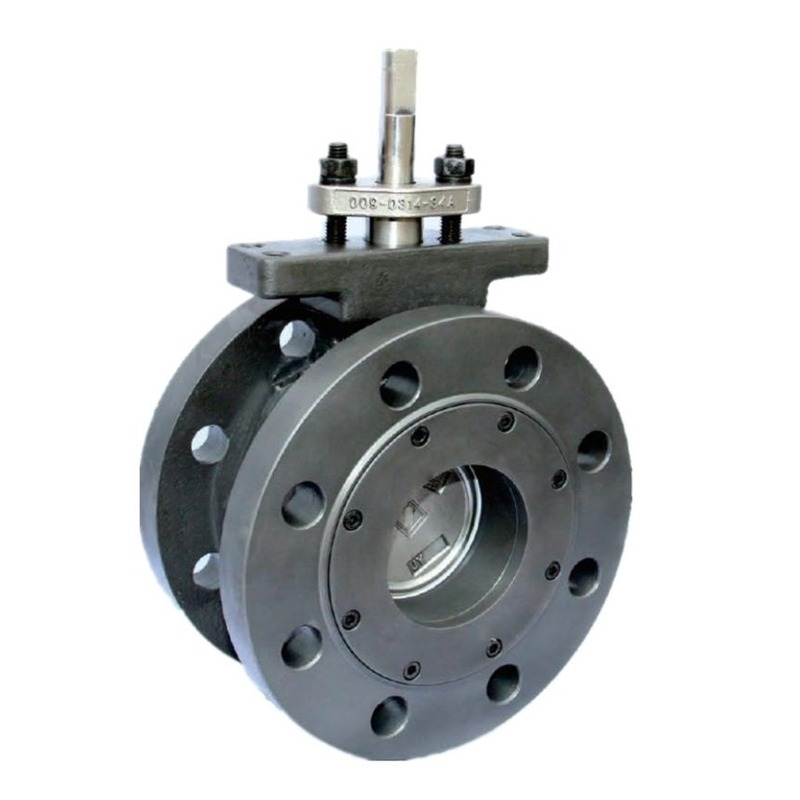
The high performance double flange butterfly valve with smooth stem is a double-offset, flange-end isolation valve built for pipelines that need compact face-to-face length, stable raised-flange installation, and a machined actuator interface without an exposed square drive or key slot. Trekre Valve supplies this smooth stem double flange butterfly valve for HVAC chilled water, district heating, industrial cooling, light hydrocarbon transfer, chemical utility headers, and general process isolation where operators may mount a worm gear, pneumatic quarter-turn actuator, or electric actuator on a standardized top flange pad.
Table of Contents
Construction and double-offset disc geometry
The valve body carries integral flanges at both ends so the unit bolts directly between pipeline flanges. A double eccentric (double offset) disc path lifts the sealing element away from the seat in the first degrees of travel, which limits scraping on PTFE, RPTFE, EPDM, or metal seat materials and keeps breakaway torque predictable on frequently cycled lines. The smooth stem extends through the top works with a finished cylindrical extension and ISO 5211-compatible mounting flange, giving actuator suppliers a concentric, rigid connection point compared with field-fabricated adapters.
Body castings are typically offered in WCB carbon steel, CF8 or CF8M stainless steel, and ductile iron for water duty, with disc and stem materials matched to medium and temperature. Seat options include resilient polymers for bubble-tight water and air service, and metal-to-metal configurations for higher temperature steam condensate or abrasive slurry where project specifications call for hardened seating surfaces. Face-to-face dimensions can be aligned with EN 558 short patterns, API 609 category layouts, or customer drawing requirements.
Smooth stem interface and actuator mounting
Process owners often standardize on ISO 5211 top flange dimensions so maintenance teams can interchange manual gear units, pneumatic scotch-yoke actuators, and electric modulating packages across a valve population. The smooth stem design presents a clean, machined stem extension and bolt circle without square drives that can gall or misalign during actuator replacement. That arrangement supports direct mounting of quarter-turn actuators while preserving stem packing integrity and reducing side load on the stem seal during automation upgrades.
For on-off duty, double-acting or spring-return pneumatic actuators provide fast response on compressor discharge headers, tank farm manifolds, and utility isolation points. Electric actuators with open-close limit switches or 4–20 mA modulating control mount to the same interface when torque and speed ratings match valve sizing. Worm gear operators with self-locking reduction remain a practical choice on elevated platforms, vault covers, or locations without instrument air, while keeping the standardized top works ready for future electric retrofit.
Double flange connection benefits
Unlike wafer designs that depend on through-bolts and gasket compression for location, the double flange body distributes pipeline loads through its own raised faces. Installers gain clearer alignment during bolt-up, and maintenance crews can remove the valve for seat inspection or actuator service while disturbing fewer adjacent joints on large-diameter lines. Confirm the selected valve’s permitted external loads against the piping support arrangement and thermal movement. Do not rely on the double-flanged connection to support an inadequately supported pipe span.
Gasket selection follows flange rating and media: compressed fibre for general water, spiral wound for hydrocarbon and steam, or PTFE envelope gaskets for corrosive chemical services. Star-pattern bolt tightening helps avoid seat distortion that could affect closure testing at rated pressure. Trekre Valve documents flange facing, bolt circle, and stem height on data sheets so EPC teams can confirm actuator clearance before lift-in.
Size, pressure, and material envelope
| Parameter | Typical range |
|---|---|
| Nominal size | DN50 to DN1200 (NPS 2 to 48) |
| Pressure class | PN10, PN16, PN25; Class 150 and Class 300 (size and seat dependent) |
| Body material | WCB, LCB, CF8, CF8M, ductile iron |
| Seat / seal | PTFE, RPTFE, EPDM, NBR, or metal seated |
| Operation | Smooth stem; worm gear, pneumatic, or electric actuator |
| Top flange | ISO 5211 (size matched to torque) |
| Design reference | API 609, EN 593, MSS SP-68 where applicable |
| Testing | Shell and seat closure per API 598 or EN 12266-1 on request |
Pressure-temperature limits depend on body class, seat material, and flange rating; final values are confirmed on the project data sheet rather than assumed from connection type alone. Carbon steel bodies with PTFE seats commonly serve chilled water and neutral process fluids, while stainless bodies with metal seats address higher temperature cycles. Leakage acceptance follows the seat design and customer test protocol.
Applications across industries
Building services engineers specify the smooth stem double flange butterfly valve on chilled and hot water mains, cooling tower isolation, and boiler bypass lines where ISO 5211 electric actuators integrate with building management systems. Municipal and industrial water treatment plants use flange butterfly valves on filter backwash, clear well isolation, and raw water intake because the double flange body simplifies later automation changes from manual gear to electric modulating control.
Petrochemical and fine chemical sites deploy carbon steel or stainless configurations on solvent, caustic, and utility lines where fire-safe requirements and corrosion allowances must be evaluated against project specifications. Power auxiliary systems employ metal seated double flange butterfly valves on condenser cooling water and lube oil coolers where temperature swings and differential pressure demand robust hard seating options. Pulp and paper, food processing, and pharmaceutical utilities also benefit from the shorter envelope compared with rising stem gate valves although the disc and shaft remain in the flow path when fully open. Confirm pressure loss from the selected valve’s flow data.
Installation, commissioning, and maintenance
Install the valve with the disc slightly open to protect seat edges during flange assembly. Verify pipeline flange facing, bolt length, and gasket type against the rating plate before lifting into line. After hydro test of the piping system, flush debris that could score seating surfaces before placing the valve in continuous service. Cycle fully open and closed under line pressure to confirm smooth operation and correct actuator direction when automated.
Inspect stem packing after thermal cycling and lubricate worm gear operators according to supplier instructions. For electric or pneumatic packages, confirm limit switch feedback, control signal range, and fail-safe position against the process safety review before energizing circuits. Planned shutdown inspections should include flange bolting, operator mounting bolts, and visual review of seat contact patterns if process conditions indicate wear.
Ordering and documentation
When requesting a smooth stem double flange butterfly valve, provide medium composition, design temperature and pressure, nominal size, flange standard and facing, preferred body and seat materials, leakage class, flow direction if applicable, cycle frequency, and intended operator type. Trekre Valve engineers confirm disc and seat pairing, ISO 5211 top flange size for actuator torque, and supply drawings, data sheets, and material certificates aligned with inspection and test plans. Extended bonnets for low temperature service, locking devices, and position indication switches are available on project request.
For related designs, compare the bare stem high performance double flange butterfly valve, the worm gear high performance wafer butterfly valve D372F, and the butterfly valve manufacturer overview on Trekre.com. Design references such as butterfly valve geometry and API 609 category layouts help align face-to-face and flange drilling with project specifications. Each configuration addresses different connection and automation preferences while sharing double-offset sealing philosophy on high performance lines.
Common selection questions
Engineers often ask how a smooth stem double flange butterfly valve differs from a wafer high performance model. The flange body carries its own end connections for direct bolting, while wafer units clamp between mating flanges and suit the shortest installation length. Both may use double-offset discs, but flange bodies are frequently chosen when pipeline loads, maintenance access, or actuator weight require a rigid end connection at each side of the valve.
Another frequent topic is resilient versus metal seating on double flange lines. Resilient seats target low leakage on water, air, and neutral fluids at moderate temperature, whereas metal seats address higher temperature or abrasive duty when the project specification defines hard seating materials. Trekre Valve selects seat and body materials against the stated medium, pressure, and temperature rather than from connection type alone.