
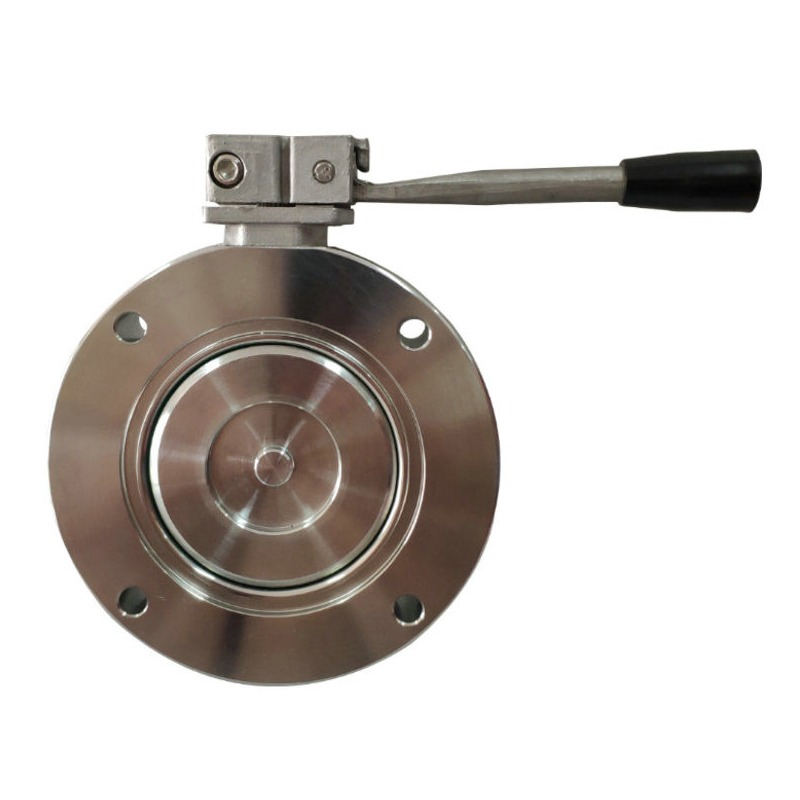

The ISO flange connected high vacuum butterfly valve is a compact quarter-turn valve for vacuum pipelines that use ISO-K style clamp flanges and elastomer O-ring seals between mating faces. Trekre Valve supplies this clamped wafer butterfly valve with manual handle operation for laboratory vacuum networks, semiconductor process tools, coating chambers, and industrial vacuum drying lines where operators need fast isolation without the face-to-face length of a double-flanged body. The disc rotates 90 degrees inside a short wafer body, giving a low-profile package suited to crowded vacuum manifolds and portable test stands.
Table of Contents
ISO-K clamp connection
Process vacuum hardware often relies on standardized ISO flange dimensions so pumps, traps, viewports, and isolation valves can be swapped without custom adapters. Confirm the exact ISO flange series, sealing arrangement and compatible clamp hardware against the approved drawing for this valve. ISO-K claw-clamp connections and ISO-KF circumferential clamping-ring connections are distinct arrangements and must not be treated as interchangeable. Compared with threaded or welded joints on small bore lines, the clamp method supports repeatable assembly during chamber maintenance and reduces handling time when technicians replace a failed valve on a foreline branch.
The wafer-style body sits between the clamped flanges, keeping axial length short for vertical pump stacks and horizontal transfer lines. Trekre machines the sealing faces to match the nominated ISO flange series on the purchase order. Confirm nominal bore, flange series, and clamp hardware compatibility with the mating chamber ports before installation, because mixed flange families will not seal correctly even when nominal diameters look similar.
Vacuum service envelope
Vacuum butterfly valves must hold a defined pressure envelope while limiting outgassing and permeation through elastomer components. Engineering data for this family references working pressures from rough vacuum through high vacuum ranges on clean, dry gas service when seat and gasket materials are selected for the actual medium and bake-out plan. Published leakage performance is stated against agreed vacuum test methods; final acceptance must follow the project test protocol and the valve inspection record rather than a generic marketing claim.
Medium temperature limits depend on seat and gasket elastomers. NBR components suit many ambient and lightly heated foreline duties within approximately −25 °C to 80 °C when confirmed against the datasheet. PTFE-based seat options extend chemical compatibility and can support higher temperature limits on selected configurations, typically up to about 150 °C when the full assembly rating is verified for the ordered materials. Cryogenic or high-bake applications require explicit material review because standard elastomers may not remain elastic enough to maintain closure torque after thermal cycling.
Valve construction
The valve consists of a stainless steel or carbon steel body, a stem and disc assembly, a replaceable seat ring, and a manual handle operator. The disc is a flat plate profile that turns on a shaft supported by bushings and a packing gland sized for vacuum duty. In the closed position the disc edge contacts the seat to block molecular flow through the bore. In the open position the disc presents minimal obstruction, which helps reduce conductance loss on pump-down manifolds compared with some poppet-style vacuum valves on the same nominal bore.
Handle rotation transfers torque through the stem to the disc without axial stem float on many production builds, limiting unintended movement that could disturb vacuum alignment on flexible bellows connections. A positive stop at open and closed positions helps operators repeat the same disc angle during routine pump isolation. For lines that cycle frequently, inspect stem packing and seat wear on a schedule tied to the plant maintenance plan.
Sealing and seat materials
Seat selection balances chemical compatibility, closure torque, and outgassing behavior. NBR resilient seats provide compliant sealing on dry air, nitrogen, and many foreline gases at moderate temperature. PTFE seats offer broader chemical resistance for process gases that would swell NBR. Metal-backed seat rings with elastomer inserts are not interchangeable across media classes; specify the actual gas composition, including trace moisture or solvent vapor, so Trekre can confirm compatible wetted materials.
Clamp flange O-rings are part of the vacuum boundary. Use O-ring compounds rated for the expected base pressure and any chamber bake-out profile. Replace O-rings whenever flanges are opened for valve service, and clean sealing grooves to remove particulate that could create virtual leaks during pump-down. Leakage class at seat closure is verified per order specification; bubble-tight wording on water tests does not automatically translate to high-vacuum molecular leak rates without the correct vacuum leak detection procedure.
Handle operation
Manual handle operation fits local isolation on vacuum skids where operators stand beside the valve during pump startup or chamber venting. The handle provides mechanical advantage for seating the disc against differential pressure across the closure element when one side is at rough vacuum and the other is nearer atmospheric pressure during vent cycles. Avoid slamming the handle at the end of stroke; controlled closure reduces seat imprinting and extends cycle life on elastomer seats.
When automation is required on adjacent branches, Trekre can quote pneumatic or electric actuators on other butterfly valve families with ISO 5211 top flanges. This ISO flange connected vacuum butterfly valve page focuses on the handle-operated clamp configuration shown in the product image for straightforward manual foreline isolation.
Size, materials, and standards
Nominal sizes follow ISO vacuum flange bore tables commonly used on vacuum hardware in China and export projects. Body materials include stainless steel for clean vacuum and corrosive foreline gases, and carbon steel for general industrial vacuum equipment when internal surface finish requirements allow. Stem and disc metallurgy is matched to the body and seat selection on each production order.
Design and connection references on typical builds include Chinese industry flange standards such as JB/T 919 and GB 6070 series dimensions for vacuum flanges, applied when the purchase specification calls for those documents. Export projects may reference equivalent ISO quick-release flange practices; provide the governing standard on the inquiry so machining and clamp hardware align with the mating components on the chamber drawing.
Reference data sheet
| Item | Typical range (confirm on order) |
|---|---|
| Valve type | ISO flange connected high vacuum butterfly valve, clamped wafer, handle operated |
| Connection | ISO-K clamp flange with O-ring seal |
| Operation | Manual handle, quarter-turn 90° |
| Pressure envelope | Rough to high vacuum on dry gas service per rated seat and test scope |
| Medium temperature | Approx. −25 °C to 80 °C (NBR seat); up to approx. 150 °C on PTFE seat variants when rated |
| Body material | Stainless steel or carbon steel (as specified) |
| Seat / gasket | NBR or PTFE seat options; vacuum O-ring per flange series |
| Standards | JB/T 919, GB 6070 (when specified); project vacuum test method as agreed |
Installation on vacuum piping
Install the valve with the disc slightly open during initial clamp tightening so the seat is not crushed by flange misalignment. Align ISO faces parallel before applying full clamp force, and verify that the O-ring sits fully inside the groove without pinching. On vertical runs, support downstream piping so clamp loads do not bend the wafer body. After assembly, perform a leak check using the project vacuum instrumentation, starting from rough vacuum and stepping down only when baseline outgassing stabilizes.
Keep hydrocarbon lubricants away from sealing surfaces on high-vacuum lines unless the maintenance procedure explicitly allows a compatible vacuum grease on specific threads outside the vacuum boundary. Cleanroom installations may require additional surface finish or handling steps; note clean-build requirements on the purchase order so packing and protection match the site rules.
Typical applications
Common uses include foreline isolation on mechanical pump sets, branch shut-off on vacuum drying ovens, laboratory vacuum manifolds, and auxiliary isolation on industrial vacuum filtration units. Semiconductor tool builders may specify this valve style on utility vacuum branches where ISO clamp hardware is already standardized across the tool frame. Pharmaceutical freeze-drying systems and metallurgical vacuum furnaces can also use clamp-connected butterfly isolation when the rated temperature and seat materials remain inside the approved envelope for the ordered build.
Maintenance and inspection
Periodically exercise the handle through a full stroke to distribute packing lubricant and confirm smooth rotation. If closure torque rises noticeably, inspect the seat for particulate embedment or elastomer compression set. Replace damaged O-rings and seat rings with Trekre approved spare parts to avoid material mismatch that increases outgassing. Document leak check results after any seat or gasket change so maintenance history stays traceable for audit-ready vacuum systems.
Ordering and test documentation
When requesting a quotation, provide nominal ISO flange size, flange series, gas composition, minimum operating pressure, maximum operating temperature, seat material preference, quantity, and the required inspection scope. Trekre can supply material certificates for pressure-containing castings and wetted elastomers, plus pressure and vacuum leak test reports aligned with the agreed protocol. Final performance limits remain those stated on the signed datasheet, nameplate, and test record for the shipped valve.
Selection questions
When should I choose a clamp ISO flange instead of a double-flanged vacuum butterfly valve? Clamp ISO connections suit compact vacuum hardware and frequent disassembly for chamber service. Double-flanged vacuum butterfly valves fit larger pipeline anchors where ANSI or EN flange pairs are already standardized on the plant side.
Can this valve throttle vacuum flow? Butterfly discs can modulate conductance in some setups, but high-performance throttling usually requires a control valve sized for stable flow at the expected pressure ratio. Confirm control objectives before using any isolation valve as a regulating element.
How is seat leakage verified? Seat leakage is reported per the order test method, which may differ from liquid seat tests used on water valves. Specify the required vacuum leak rate and detection procedure during procurement.
Does handle orientation matter? Yes. Confirm handle clearance relative to chamber panels, cable trays, and adjacent clamps. Trekre can note preferred handle direction on the manufacturing traveler when the piping isometric is supplied with the order.