
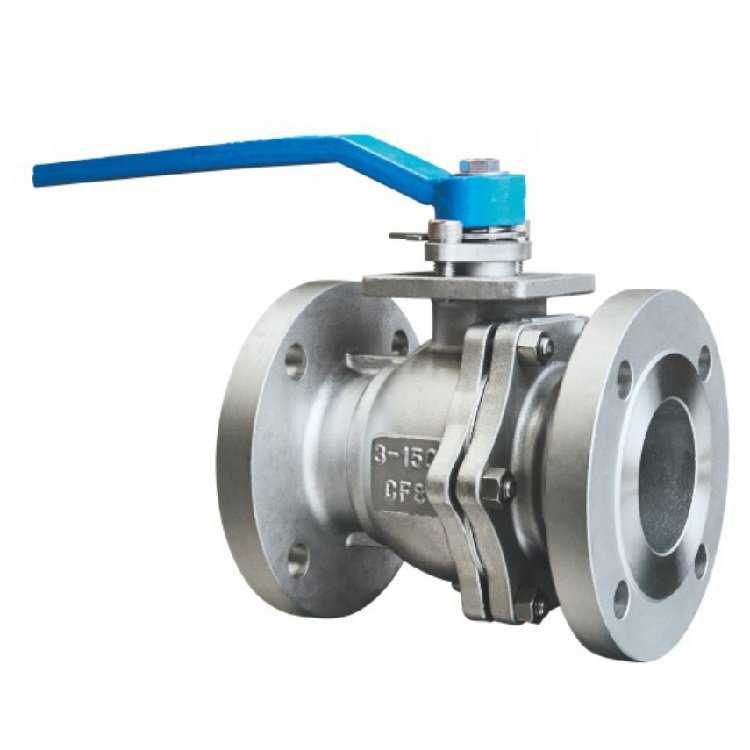

We are a ball valve manufacturer in China. ANSI Class 150 Flanged Ball Valve is a kind of on-off valve. The valve adopts 150LB American standard and is assembled from stainless steel CF8 and CF8M castings. It is usually a handle switch. Large-diameter can be equipped with a worm gear operating device. , the upper flange connection plate conforms to the ISO 5211 standard, and can also be equipped with electric or pneumatic actuators
ANSI Class 150 Flanged Ball Valve Structure diagram

ANSI Class 150 Flanged Ball Valve Construction Materials
This Class 150 flanged ball valve uses a rotating ball and seat arrangement for quarter-turn isolation. The listed material families include cast carbon steel and cast stainless-steel body options, with a PTFE soft-seated construction.
| Component | Material or construction identified |
|---|---|
| Valve body | WCB cast carbon steel; CF8 or CF8M cast stainless-steel options listed for this product |
| Ball | 304 / 316 stainless-steel material options |
| Stem | 304 / 316 stainless-steel material options |
| Seat | PTFE seating configuration |
| Stem packing | PTFE packing configuration |
The selected valve assembly must use compatible pressure-boundary and sealing materials. Pressure-temperature rating and replacement-part identification depend on the corresponding approved construction and component schedule.
ANSI Class 150LB Flanged Ball Valve is mainly used to cut off, distribute and change the flow direction of the medium in the pipeline. It can be closed tightly only by rotating 90 degrees and a small rotating torque. Ball valve is most suitable for switch and shut-off valve
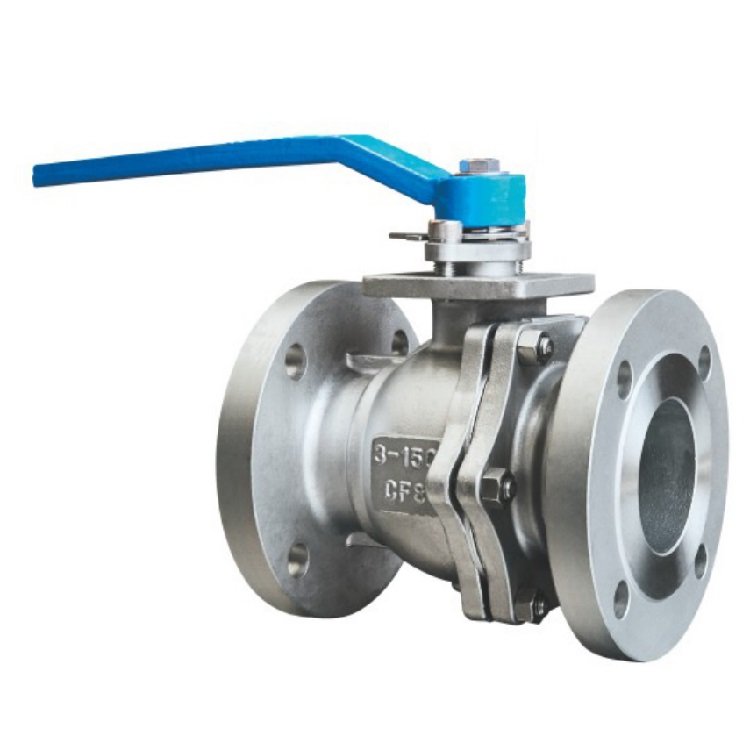
Stainless Steel ANSI Class 150 Flanged Ball Valve advantage
- The fluid resistance is small, and its resistance coefficient is equal to that of the pipe section with the same length.
- Simple structure, small volume and light weight.
- It is tight and reliable. Plastic is widely used as the sealing surface material of the ball valve, with good sealing performance. It has also been widely used in the vacuum system.
- Easy operation, quick opening and closing, only 90 ° rotation from full opening to full closing, convenient for remote control.
- The maintenance is convenient, the ball valve structure is simple, the sealing ring is generally movable, and the disassembly and replacement are relatively convenient.
- When the valve is fully opened or fully closed, the sealing surface of the ball and the valve seat is isolated from the medium. Confirm resistance to erosion for the actual medium, solids content and operating duty; the valve type alone does not establish immunity from erosion.
- Wide range of application, the diameter is from a few millimeters to a few meters, and can be applied from high vacuum to high pressure
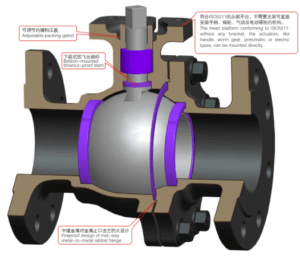
Stainless Steel ANSI 150 Flanged ball valve explain
The working principle of the American standard flanged ball valve is to make the valve unblocked or closed by rotating the valve core. The ball valve switch is light, small in size, can be made into a large diameter, reliable sealing, simple structure, convenient maintenance, sealing surface and spherical surface are often in a closed state, not easy to be eroded by the medium, and are widely used in various industries. Flanged ball valve has its own unique advantages, such as no friction on switch, easy to wear seal, small opening and closing torque, which can reduce the size of the actuator. It is widely used in the working conditions with strict water supply and drainage requirements in petrochemical cities.
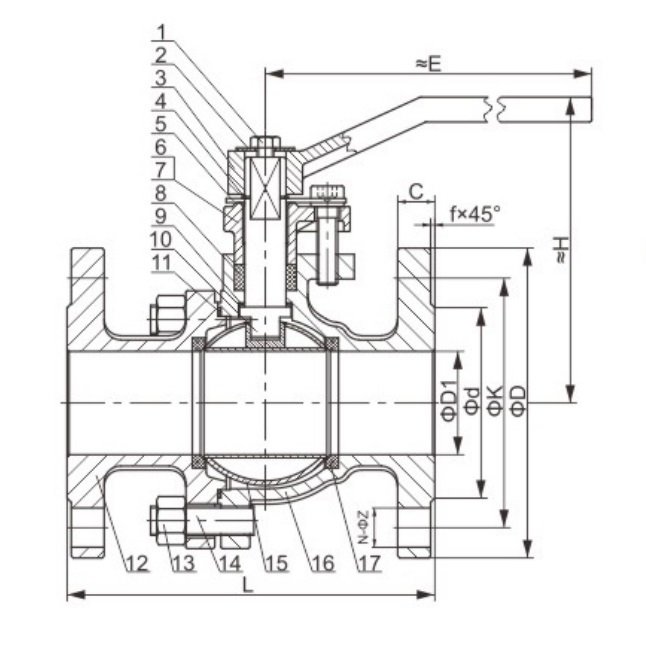
Stainless Steel ANSI Class 150 Flanged Ball Valve Main External and Connecting Dimensions
| NPS | D1 | d | K | D | C | f | N-OZ | L | H E | E |
| 1/2″ | 15 | 34.9 | 60.3 | 90 | 14 | 1 | 4-16 | 108 | 79 | 125 |
| 3/4″ | 20 | 42.9 | 69.9 | 100 | 16 | 1 | 4-16 | 117 | 82 | 125 |
| 1″ | 25 | 50.8 | 79.4 | 110 | 16 | 1 | 4-16 | 127 | 102 | 155 |
| 1 1/4″ | 32 | 63.5 | 88.9 | 115 | 18 | 2 | 4-16 | 140 | 106 | 155 |
| 1 1/2″ | 38 | 73 | 98.4 | 125 | 18 | 2 | 4-16 | 165 | 128 | 240 |
| 2″ | 50 | 92.1 | 120.7 | 150 | 18 | 2 | 4-19 | 178 | 135 | 240 |
| 2 1/2″ | 65 | 104.8 | 139.7 | 180 | 20 | 2 | 4-19 | 190 | 145 | 280 |
| 3″ | 78 | 127 | 152.4 | 190 | 22 | 2 | 4-19 | 203 | 160 | 320 |
| 4″ | 98 | 157.2 | 190.5 | 230 | 24 | 2 | 8-19 | 229 | 180 | 320 |
| 5″ | 123 | 185.7 | 215.9 | 255 | 26 | 2 | 8-22 | 356 | 252 | 530 |
| 6″ | 148 | 215.9 | 241.3 | 280 | 28 | 2 | 8-22 | 394 | 285 | 630 |
| 8″ | 198 | 269.9 | 298.5 | 345 | 30 | 2 | 8-22 | 457 | 385 | 800 |
| 10″ | 248 | 323.8 | 362.0 | 405 | 34 | 2 | 12-25 | 533 | 485 | |
| 12″ | 298 | 381.0 | 431.8 | 485 | 36 | 3 | 12-25 | 610 | 545 | |
| 14 | 348 | 412.8 | 476.3 | 535 | 44 | 3 | 12-25 | 686 | 635 |
Product Overview
This product is presented for pipeline isolation with a flanged Class 150 designation. Confirm the selected construction and service conditions before ordering.
Selection Notes
Confirm the medium, pressure and temperature conditions, size, flange, body and seat materials, shutoff requirement and operating method. Product-specific limits require datasheet confirmation.
FAQ
Is this valve identified as Class 150?
Yes. The title identifies Class 150; confirm the final pressure designation for the selected configuration.
Which body materials are listed?
The current page lists CF8 and CF8M. Confirm the complete material specification for the selected valve.
Can another operating arrangement be selected?
The current page refers to other operating arrangements for selected configurations. Confirm the required operation before ordering.