
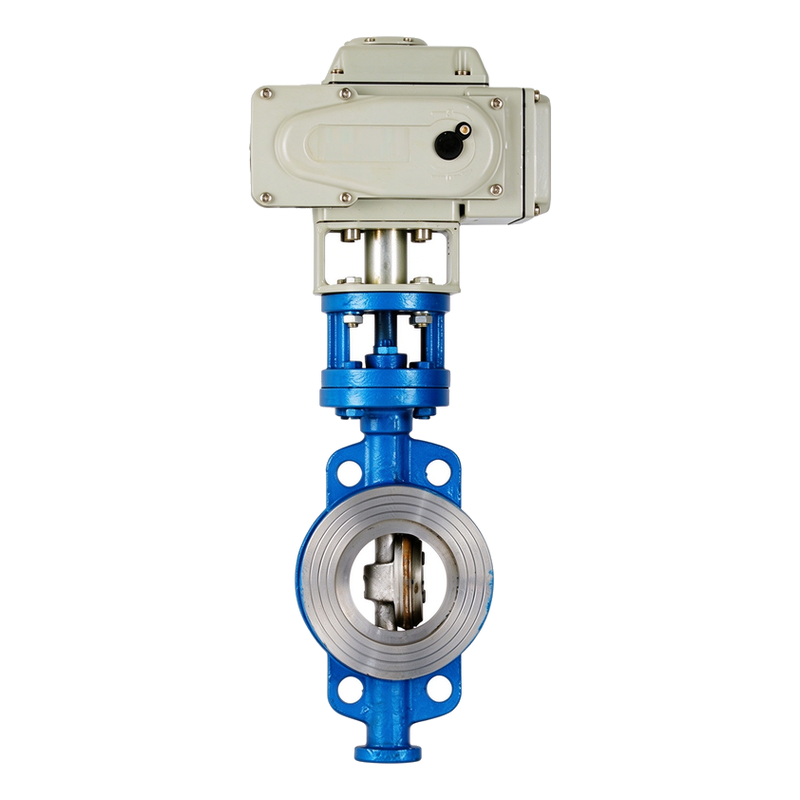

The electric triple offset hard seal wafer butterfly valve D973H is a compact quarter-turn valve for pipelines that need metal seated shutoff, bidirectional sealing and remote electric operation without the long face-to-face of a double flanged body. Trekre Valve builds this wafer type butterfly valve with a triple eccentric disc path, Stellite or stainless overlay seat options, and a multi-turn electric actuator for switching or modulating duty on steam, hot oil, metallurgical gas, petrochemical process fluids and industrial cooling water in power, steel, chemical, water treatment and HVAC systems.
Table of Contents
Triple offset sealing geometry
Triple offset butterfly valves move the disc on an inclined axis so the sealing ring lifts away from the seat during opening instead of sliding across it. The first offset places the stem axis behind the disc center line; the second shifts the stem axis off the valve bore center; the third angles the seat cone relative to the bore axis. On closing, the disc wedges into the metal seat with line contact, which supports tight shutoff on elevated temperature and pressure when the seat overlay and body alloy match the service.
The D973H series uses a metal hard seal between disc and seat. Seat surfaces can be hardfaced with Stellite alloy or finished on stainless steel rings depending on erosion and corrosion expectations. Shutoff class and allowable leakage follow the test method named on the purchase order; Trekre does not substitute a verbal leakage promise for the agreed factory or witness test report.
Compared with centerline resilient seated wafer butterfly valves, this electric triple offset hard seal wafer butterfly valve tolerates higher temperature and higher differential pressure when the hard seal pair is chosen correctly. Compared with the double flanged D943H format, the wafer body reduces axial length and fits between companion flanges that share through bolts, which is common on steam headers, district energy branches and equipment isolation spools in crowded pipe racks.
Wafer connection and internal layout
The valve body is wafer style: it sits between two pipeline flanges and is clamped by bolts that pass through the flanges. Confirm the applicable face-to-face standard, category and dimensions for the ordered pressure class against the purchase specification and approved valve drawing. Integrators must confirm flange standards, bolt circle, gasket type and whether the line design uses full through bolts or stud pairs, because wafer valves rely on the flange assembly for end load restraint.
Body castings are supplied in carbon steel WCB, stainless CF8 or CF8M, or alloy grades when the data sheet requires them. The disc is typically stainless or alloy steel with optional surface treatment matched to the seat overlay. A stable stem bearing set and adjustable packing gland limit stem emissions within the environmental limits stated in the project specification. The triple eccentric disc path reduces seat scrubbing during partial stroke, which helps maintain metal contact on modulating loops when the actuator is sized for frequent movement.
Electric actuator and control options
A multi-turn electric actuator can drive a butterfly valve through a matched part-turn gearbox, converting multiple input rotations into the quarter-turn movement of the valve. Confirm the supplied actuator and gearbox combination, required torque, operating time and control functions when ordering. Switching actuators provide open and closed limit feedback for interlocked pump, burner or compressor sequences. Modulating actuators accept 4–20 mA or 0–10 V control signals for flow trimming where the installed piping characteristic allows disc throttling. Optional position transmitters, torque switches and fieldbus modules are selected against the DCS or PLC architecture.
Local handwheel or clutch mechanisms on many actuator models allow manual operation during power loss, subject to site lockout rules. Motor enclosures, duty classes and optional explosion-proof enclosures are selected against the electrical area classification and ambient temperature. Integrators should confirm actuator runtime, duty cycle and stem torque curve together with the valve data sheet rather than assuming a generic actuator catalog rating covers throttling service on large bore discs.
Nominal sizes, pressure and temperature
Nominal diameter range commonly spans DN50 through DN1200 (NPS 2 through 48) with engineering review for extreme sizes and actuator mounting height. Pressure ratings include PN10, PN16, PN25 and PN40 equivalents, plus Class 150 and Class 300 flange pairings where the piping standard demands them. Temperature capability depends on body alloy, seat overlay, gasket materials in the flange package and actuator component limits; steam, hot oil and high temperature gas duties require explicit minimum and maximum temperature on the inquiry.
Flow resistance remains lower than many gate or globe alternatives of similar bore, which reduces pumping energy on large water and cooling circuits. Cavitation, flashing and high velocity slurry service still need application review because metal seated triple offset valves are not a universal substitute for specialized erosion control designs. For abrasive solids, upstream filtration or flushing procedures may be required to protect seat lands during long shutdown intervals.
Factory assembly includes pairing of disc, seat overlay and actuator based on the approved datasheet. Each valve receives shell and seat pressure tests before release, with reports aligned to GB/T 13927 or API 598 when named on the order. Integrators planning DCS tie-in should list required feedback signals, motor starter type and cable entry orientation so the electric triple offset hard seal wafer butterfly valve D973H arrives ready for terminal connection on site.
Typical applications
Specify the D973H on steam isolation branches, thermal oil circuits, metallurgical off-gas headers, refinery intermediate lines, flue gas desulfurization absorber recirculation, steel mill cooling water mains and other duties where metal sealing, wafer compactness and electric automation are required together. The bidirectional seat arrangement simplifies installation orientation on many pipelines, but engineers should still confirm preferred flow direction, flushing requirements and any upstream isolation needs on abrasive media.
Installation, testing and maintenance
Install with pipeline flanges aligned and gaskets selected for the flange finish and service temperature. Tighten flange bolts in a cross pattern so the wafer body is drawn evenly between the flanges without cocking the disc. Cycle the valve partially open during bolt-up to protect seat contact faces. Wire the actuator according to the supplied diagram, verify phase rotation and torque or position limits, then perform a controlled closure test against the project leak test procedure.
Maintenance includes periodic stem packing adjustment, actuator lubrication per the actuator manual, and inspection of seat surfaces during planned outages. Heavy solids or scale on the seat land may require cleaning before metal contact is restored. Spare actuator fuses, position feedback modules and seat inspection records should be archived with the valve serial number from the Trekre factory test package.
Product parameters
| Item | Specification |
|---|---|
| Model | D973H electric triple offset hard seal wafer butterfly valve |
| Structure | Triple eccentric metal seated disc, wafer body |
| Connection | Wafer (clamped between flanges; GB / ANSI / JIS / EN as ordered) |
| Size range | DN50 – DN1200 (NPS 2 – 48), confirm large sizes at order |
| Pressure class | PN10 – PN40; Class 150 / 300 (project specific) |
| Body material | WCB, CF8, CF8M, alloy steel (as specified) |
| Seal | Metal hard seal; Stellite or stainless seat overlay options |
| Operation | Electric multi-turn actuator; on-off or modulating control |
| Temperature | Per body, seat, gasket and actuator selection on data sheet |
| Standards | API 609, MSS SP-68, GB/T 12238, GB/T 13927 (as agreed) |
| Test | Shell and seat test per order specification and test report |
Selection questions
When should I choose D973H instead of a soft seated electric wafer butterfly valve?
Metal triple offset designs are considered when temperature, abrasive media or differential pressure exceed practical limits for elastomer seats. Provide medium, temperature, pressure and required shutoff test method so engineering can compare D973H against lined or resilient wafer alternatives.
What is the difference between D973H and double flanged D943H?
Both use triple offset metal sealing and electric actuation. D973H wafer bodies minimize face-to-face length and depend on flange bolts for end restraint, which suits many inline isolation points. D943H double flanged bodies carry integral flanges on both ends and are often chosen for larger line loads or when the specification names a flanged end valve explicitly.
What actuator data should I send with the inquiry?
Include supply voltage, control signal, required fail position, enclosure class, area classification and whether switching or modulating duty is needed. Torque sizing uses valve bore, design pressure and medium; attach the piping isometric and operating sequence when available.