
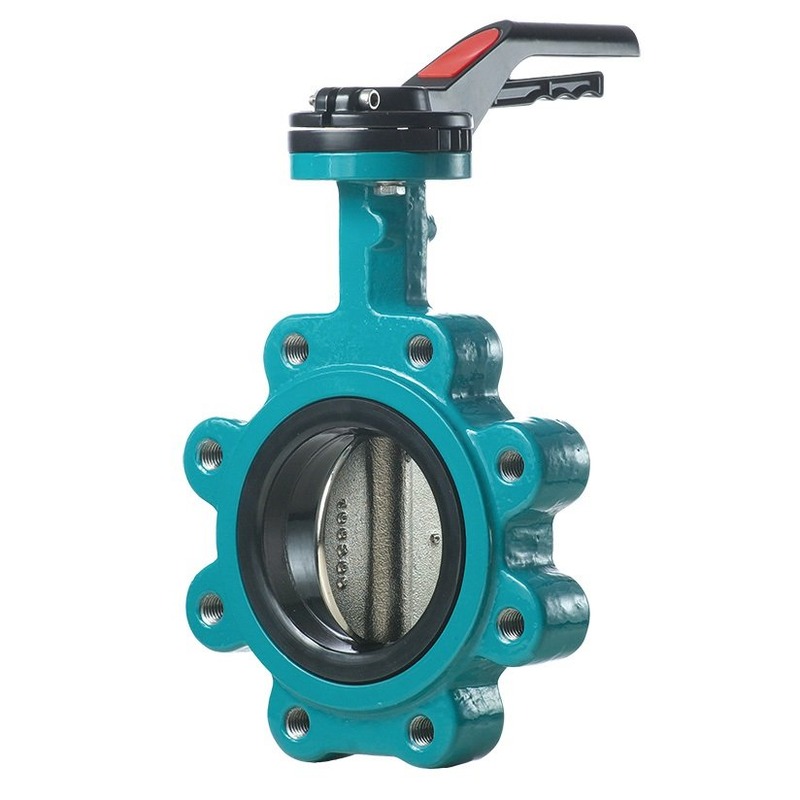

The handle lug ductile iron QT450 resilient seat butterfly valve is a centerline quarter-turn isolation valve with cast lug ears for flange-side bolting, a lever handle for local operation, and a ductile iron QT450 body suited to waterworks, HVAC, fire protection branches, irrigation headers, and general industrial utility piping. Trekre Valve manufactures this lever operated lug butterfly valve at our Wuxi facility with interchangeable resilient or PTFE seat rings, stainless or ductile iron disc options, and flange drilling aligned to ANSI Class 150, EN PN10/PN16, JIS 10K, or project-specific standards. The QT450 designation applies to the body casting; disc, stem, seat, and packing materials are selected separately for the actual fluid, temperature, and pressure on the line.
Table of Contents
Structure and working principle
Centerline butterfly valves place the stem axis through the geometric center of the disc. The disc rotates 90 degrees within the cylindrical bore of the QT450 ductile iron body, compressing the seat ring at full closure. Internal stem bearings and a packing gland support the stem while allowing hand torque from the lever to stroke the disc without excessive friction on clean water and air services. Lug-type bodies incorporate threaded or through-bolt ears on each flange face so each pipeline flange can be bolted to the valve body independently of the companion flange on the opposite side, which simplifies maintenance layouts compared with wafer bodies that rely entirely on through bolts spanning both flanges.
The lever handle attaches directly to the stem or to a square drive extension with mechanical stops that define fully open and fully closed positions. Position indicators on the handle or bonnet help operators confirm valve state during walk-down inspections. This handle lug QT450 butterfly valve does not include a pneumatic or electric actuator; automated packages on the same lug body pattern are covered under separate Trekre pneumatic lug and electric lug product pages when ISO 5211 mounting and actuator torque must be integrated.
Lug body and flange connection
Lug connections permit bolting each flange to the valve body, but they do not automatically prove end-of-line or dead-end pressure capability for every size and seat combination. Confirm documented ratings, flow direction limits, and safe isolation steps before removing downstream pipework while upstream pressure remains in the line. PN, Class, and JIS flange designations are not directly interchangeable: verify bolt circle, face type, face-to-face length, and disc clearance against the approved isometric before ordering companion flanges and gaskets.
Align piping to avoid side load on the stem and uneven compression of the wafer-like lug faces. Support heavy adjacent spools so dead weight does not hang on the valve beyond the flange design. Gasket selection follows the seat material and installation instructions for the supplied model; do not assume a universal full-face gasket rule across all resilient seat lug valves without checking the manufacturer drawing.
Lever handle operation
Local lever operation suits infrequent isolation, sampling branches, drain headers, and equipment tie-ins where remote actuation is unnecessary. Hand torque remains practical on many nominal sizes when differential pressure, disc condition, and seat material match municipal water or low-pressure air duty. On larger diameters or higher shutoff differentials, compare this handle lug ductile iron butterfly valve with worm gear operated lug models that multiply torque through a gearbox while keeping the same lug body and seat assembly.
A locked lever or padlock provision, when supplied, assists administrative control but does not replace formal lockout/tagout, depressurization, and verification of zero energy before maintenance. Exercise the valve through several open-close cycles during commissioning to confirm stops, packing adjustment, and seat contact before placing the line in continuous service.
Body, disc and seat materials
The standard body material is ductile iron QT450, chosen for strength, machinability, and satisfactory performance in potable water, chilled water, air, and mild chemical services within the alloy temperature limit stated on the project datasheet. Alternative body grades include cast steel WCB or stainless CF8 and CF8M when specifications require different mechanical strength or corrosion resistance. Disc options commonly include ductile iron with nickel plating or epoxy coating, stainless steel 304 or 316 plate, or cast stainless compatible with the selected seat.
Resilient seats include EPDM for potable and HVAC water, NBR for oil-bearing air within elastomer limits, and VITON where higher temperature elastomer service is specified. PTFE or molded PTFE composite seats address more aggressive chemicals within the liner temperature envelope. Evaluate every wetted component against concentration, temperature, cleaning agents, and permeation risk; a resilient liner does not remove the need to assess metallic parts that may contact process fluid through damage, wear, or isolation boundary failure.
Sealing form and operating limits
Primary shutoff relies on disc-to-seat compression at the closed position. Bidirectional closure capability, allowable leakage, and shutoff differential depend on the actual seat compound, test standard, test medium, hold time, and direction stated on the purchase order. Resilient centerline lug valves provide economical isolation on water and compatible utilities; they are not interchangeable with triple-offset metal seated valves on high-temperature steam or abrasive slurry duty without a full application review.
Continuous throttling or partial opening for flow control requires Cv data, cavitation review, and actuator duty analysis. A lever-operated isolation valve used partly open for long periods may experience accelerated seat wear or noise; specify a control valve or a characterized disc design when modulation is a primary function rather than occasional isolation.
Typical applications
Handle lug QT450 resilient seat butterfly valves appear on building chilled and hot water risers, fire protection zone branches, irrigation pump discharge headers, wastewater collection manifolds, compressed air distribution tees, and packaged skid isolation points where lug maintenance access and ductile iron economy are both required. They serve as sectioning valves on horizontal mains and vertical risers when lever access from a platform or corridor is acceptable.
They are not a substitute for fully lined lug valves on strong oxidizers or hydrofluoric acid service, nor for high-performance double-eccentric designs on elevated steam temperature without confirming seat and body limits. When slurry solids or abrasive particulate loading is high, consult Trekre application staff on seat material, disc coating, and whether a high-performance or lined format better matches the pipeline duty.
Installation and maintenance
Install with the handle oriented for safe operation and maintenance access. Tighten flange bolts in a cross pattern to equalize gasket load and avoid distorting the lug faces. After thermal cycling, inspect the packing gland for weeping and adjust evenly if needed; overtightening can increase operating torque and accelerate packing wear. Store spare valves with the disc slightly off the seat and protect elastomer components from ozone, direct sunlight, and compression set during long warehouse periods.
Periodic operation on infrequently used lines helps prevent scale buildup and packing consolidation. Record seat leakage trends during scheduled shutdown tests using the agreed test method; closure performance is verified against the factory or witness test report rather than assumed from generic verbal ratings.
Product parameters
| Item | Specification |
|---|---|
| Valve type | Handle lug ductile iron QT450 resilient seat butterfly valve |
| Structure | Centerline disc, lug body with flange ears |
| Size range | DN50 – DN1200 (NPS 2 – 48; confirm for project class) |
| Pressure rating | PN10, PN16; JIS 10K; ANSI Class 150 (as ordered) |
| Body material | Ductile iron QT450; WCB, CF8/CF8M optional |
| Disc material | QT450, stainless steel 304 / 316 (as specified) |
| Seat material | EPDM, NBR, PTFE, VITON (as specified) |
| Operation | Lever handle, 90° stroke |
| Connection | Lug type, flange drilling per ANSI / EN / JIS / GB as ordered |
| Design standard | EN 593, MSS SP-67, API 609, GB/T 12238 (as agreed) |
| Test | Shell and seat test per order; leakage per agreed standard and test report |
Common questions
Does a lug body automatically allow pressurized end-of-line service?
No. Confirm the specific design, size, direction, and documented end-of-line rating, and isolate safely before dismantling downstream pipework.
When should I choose handle lug QT450 instead of a wafer handle valve?
Select lug bodies when maintenance layouts require independent flange bolting at the valve or when project specifications name lug ears for sectioning. Wafer designs remain economical when through-bolt clamping between flanges is acceptable and lug access is not required.
What should I send to a China valve manufacturer for quotation?
Include medium, temperature, pressure, shutoff differential, nominal size, flange standard, seat preference, body and disc materials, quantity, and required test certificates. State whether end-of-line duty is planned so bolting and rating can be confirmed on the drawing.