
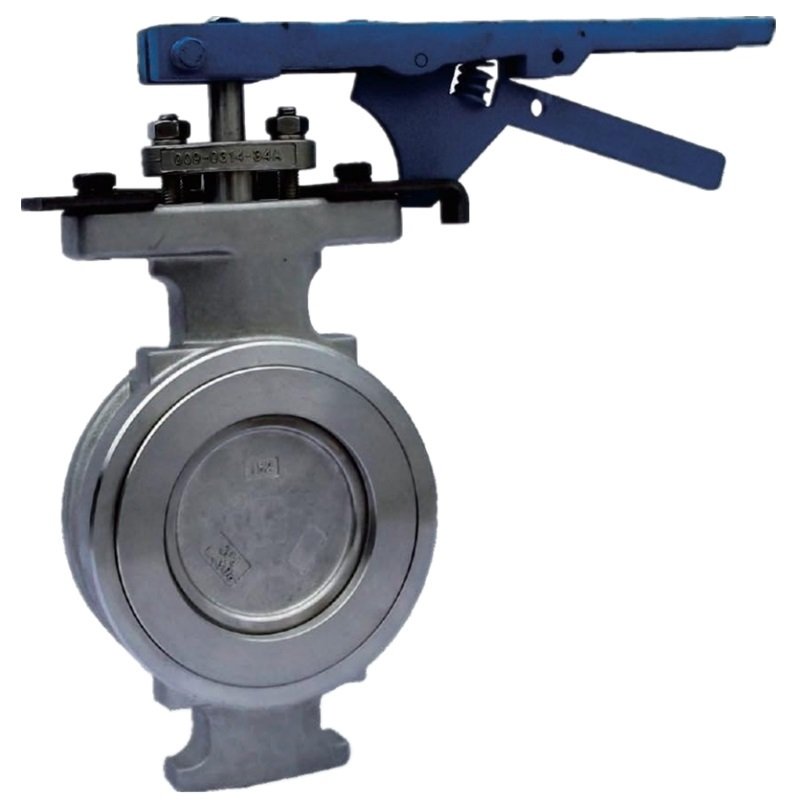

The handle wafer high performance butterfly valve is a double eccentric quarter-turn shutoff valve for pipelines that need tighter sealing than centerline soft-seated designs while keeping a short wafer face-to-face length and manual lever operation. Trekre Valve supplies this handle operated high performance wafer butterfly valve with carbon steel or stainless steel bodies, metal hard seal or resilient soft seal seat options, and a lever handle for local isolation on steam branches, hot water mains, vacuum headers, and general industrial utility lines where bi-directional pressure capability and repeatable shutoff matter.
Table of Contents
Double eccentric sealing geometry
High performance butterfly valves use double eccentric disc motion so the disc lifts away from the seat during opening instead of dragging across the full sealing surface. The first eccentric offset places the stem axis behind the disc center line; the second shifts the stem axis off the bore center. On closing, the disc engages the seat with controlled contact pressure, which supports shutoff on higher temperature and pressure than typical centerline resilient seated wafer valves when the seat type and body alloy match the service.
This handle wafer high performance butterfly valve is also referred to as a handle double eccentric butterfly valve in project specifications. Metal seated configurations use hardened stainless or overlay finished seat rings for steam, thermal oil, and erosive industrial media. Soft seated configurations use molded elastomer or PTFE-based seat elements when lower leakage targets on water, air, or chemical services are required at moderate temperature. Shutoff class and allowable leakage follow the test method named on the purchase order; confirm results on the factory or witness test report rather than assuming a generic verbal rating.
For mixed-flow headers, confirm the selected valve’s shutoff rating in each pressure direction, including the permitted differential pressure and agreed test conditions. Double-eccentric geometry or resilient seating alone does not establish that rating. Confirm the supplied model marking, seat orientation, and any flow-direction arrows against the approved drawing before installation.
Wafer body and flange connection
Wafer-style bodies install between two pipeline flanges. Through bolts or stud pairs clamp the valve between companion flanges. Confirm the actual mating-flange standard, drilling, facing, fasteners and installation dimensions against the approved valve drawing and project piping specification; distinguish these connection requirements from the applicable valve product standard. Locating lugs align the valve on the bolt circle so the short face-to-face dimension fits retrofits in mechanical rooms, vertical risers, and packaged skids where double flanged valves would require longer spool pieces.
Body castings are offered in WCB carbon steel for general industrial duty and CF8 or CF8M stainless steel when corrosion resistance or higher temperature oxidation limits are specified. Integrators should verify gasket type, bolt length, and whether the line uses full through bolts, because the wafer body relies on the flange assembly for end restraint and must not carry unsupported pipeline weight.
Handle operation and stroking
A lever handle drives the stem through a nominal 90-degree stroke from fully open to fully closed. Mechanical stops or position indicators help operators confirm end positions without counting partial turns. Hand torque stays practical on many clean water, air, and low-viscosity services when the valve is sized for the stated differential pressure and disc is free of scale or deposits.
For nominal sizes above the hand-torque comfort range, or when differential pressure increases break torque, compare this handle wafer high performance butterfly valve with worm gear operated double eccentric wafer models or pneumatic and electric actuated high performance wafer alternatives on the same bore and flange class. Frequent automated cycling, remote indication, or interlocking with plant controls generally require an actuator rather than a fixed lever.
Metal hard seal versus soft seal seats
Metal hard seal seats suit elevated temperature, higher pressure, and abrasive media when seat overlay material and body alloy are chosen for the loop chemistry. Soft seal seats suit water distribution, HVAC, and many chemical services where elastomer or PTFE contact surfaces meet the temperature and compatibility limits on the data sheet. Seat rings on high performance designs are often replaceable in the field when the manufacturer procedure allows, which reduces downtime on long-running plants.
Do not mix seat types across bidirectional lines without confirming compatibility with both flow directions and with any pigging or cleaning methods used in the pipeline. Vacuum service and rapid thermal cycling should be noted on the inquiry so packing, bearing, and seat compound selections are reviewed before production.
Materials, pressure classes and size range
Typical pressure ratings include Class 150 and Class 300 per ASME, PN10 and PN25 per EN, and JIS 10K and 20K classes as ordered. Nominal size coverage commonly spans 2 inch through 60 inch (DN50 through DN1500) with larger or special face-to-face lengths available when the project specifies a matching standard.
Disc materials are commonly stainless steel plate or cast stainless compatible with the seat type. Stem and packing sets are selected for the stated temperature and whether the valve is used outdoors, in a steam vault, or in a wash-down area. Coating systems on carbon steel bodies may include epoxy or polyurethane paint systems suitable for the installation environment.
Typical applications
Handle wafer high performance butterfly valves appear on district heating branches, boiler feed isolation, pulp and paper white-water headers, power plant auxiliary cooling, metallurgical gas manifolds, and chemical transfer lines where double eccentric sealing and compact wafer length are required together. They serve as isolation valves, bypass legs, and equipment isolation points when paired with downstream control valves or pumps.
They are not a substitute for triple-offset metal seated valves on every high-temperature steam duty, nor for fully lined valves on strong oxidizers or hydrofluoric acid services. When media is highly corrosive or solids loading is extreme, review lined butterfly formats or alternate valve types and confirm test methods on the inquiry.
Installation, storage and maintenance
Install the valve with the handle accessible and flange bolts tightened in a cross pattern so the wafer body is not pulled unevenly, which could distort the seat and affect shutoff. Support adjacent heavy piping so dead weight does not load the valve beyond the flange design. Open and close slowly on first return to service after a long shutdown while checking the packing gland for weeping; tighten packing evenly if needed.
For storage, keep the disc slightly off the seat, protect elastomer components from ozone and direct sunlight, and keep internals dry to avoid seat compression set. Periodic exercise helps prevent packing consolidation and scale buildup on infrequently operated lines.
Product parameters
| Item | Specification |
|---|---|
| Model | Handle wafer high performance butterfly valve (double eccentric) |
| Structure | Double eccentric disc, wafer body |
| Connection | Wafer between flanges (ANSI / EN / JIS / GB as ordered) |
| Size range | 2" – 60" (DN50 – DN1500; confirm for project class) |
| Pressure class | Class 150 / 300; PN10 / PN25; JIS 10K / 20K (as ordered) |
| Body material | Carbon steel WCB or stainless CF8 / CF8M |
| Seat seal | Metal hard seal or soft seal (elastomer / PTFE per specification) |
| Operation | Lever handle, 90° stroke |
| Temperature | Per seat type and packing on approved data sheet |
| Standards | API 609, MSS SP-68, GB/T 12238 (as agreed on order) |
| Test | Shell and seat test per order; leakage per agreed standard and test report |
Selection questions
When should I choose a handle high performance wafer valve instead of a centerline soft seal D72X type?
Select double eccentric high performance wafer valves when the line needs higher temperature or pressure headroom, metal seated shutoff options, or bi-directional sealing beyond typical centerline elastomer limits. Stay with centerline soft seal handle wafer valves on low-pressure clean water and air when cost and hand torque are the main drivers.
Can one valve cover both metal and soft seat requirements on the same RFQ?
Metal and soft seat variants are different seat assemblies and test documents. Specify the medium, temperature, pressure, leakage class, and flow direction on the inquiry so the factory quotes one consistent seat type rather than mixing incompatible options.
What information should I send to a China valve manufacturer for a handle wafer high performance butterfly valve quote?
Include medium, design temperature, design pressure, nominal size, flange standard, seat type preference, body material, coating requirements, quantity, and required test certificates. Attach a flange detail or isometric so wafer bolt length and lug hole pattern are verified before production.