
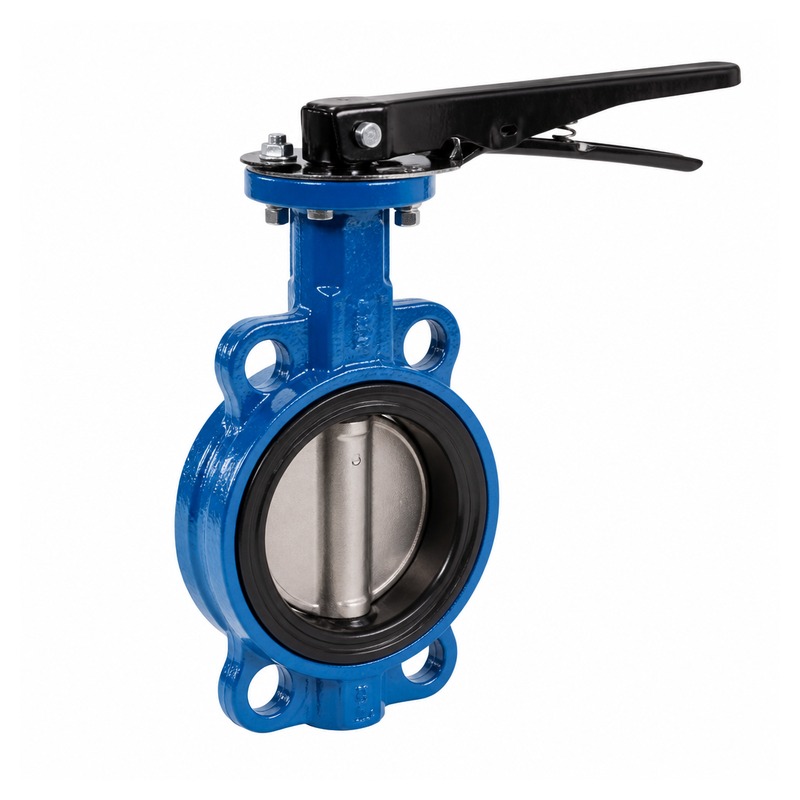

The handle wafer soft seal butterfly valve D72X is a centerline, quarter-turn shutoff valve for water, air and light-duty process lines where a short face-to-face length and manual operation are preferred over automated actuators. Trekre Valve supplies this D72X handle wafer soft seal butterfly valve with ductile iron or carbon steel wafer bodies, stainless or rubber-lined discs, and resilient NBR or EPDM seats for municipal water, building HVAC, fire protection, cooling water and general industrial utility piping. The wafer body installs between two companion flanges; through bolts or studs clamp the valve in place so the pipeline carries end loads while the valve keeps a compact envelope in crowded mechanical rooms and vertical risers.
Table of Contents
Centerline soft seal design
Centerline butterfly valves place the stem axis on the disc center line so the disc rotates in the bore with minimal eccentricity. On closing, the disc edge presses the elastomer seat to build sealing contact around the full periphery. On opening, the disc clears the seat quickly, which limits seat scrubbing compared with some offset designs and keeps hand torque moderate on clean water and air services.
The D72X series uses soft sealing between a metal or rubber-faced disc and a molded resilient seat ring. Confirm the complete model designation and actual disc and seat arrangement against the approved product drawing and order documentation. Suffix pressure classes such as D72X-10Q and D72X-16Q indicate nominal pressure ratings on the ductile iron body option. Confirm bidirectional sealing capability for the supplied valve configuration. Follow the flow-direction markings and approved installation instructions for that valve.
Shutoff performance is verified by the shell and seat tests named on the purchase order. Allowable leakage follows the agreed standard such as GB/T 13927 or API 609 for resilient seated valves; confirm results on the factory test report rather than assuming a verbal class rating.
Wafer body and connection layout
Wafer-style bodies fit between two pipeline flanges. Locating lugs or through holes align the valve with flange bolt circles per GB/T 12238, HG/T 20592, ANSI B16.5 or equivalent project standards. Integrators must confirm gasket type, bolt length, and whether the line uses full through bolts or stud pairs, because the wafer valve relies on the flange assembly for end restraint.
Face-to-face length is short relative to double flanged valves, which helps retrofits in tight spools and packaged skids. The body is commonly cast ductile iron QT450-10 for cost-effective water and HVAC service, with WCB or stainless options when specifications require higher strength or corrosion resistance. Disc options include stainless steel plate in SS304 or SS316, or ductile iron with rubber lining when a softer wetted face is desired.
Handle operation and torque
A lever handle drives the stem through a nominal 90-degree stroke from fully open to fully closed. Many assemblies include a mechanical stop or position indicator so operators can see open and closed limits without counting turns. Hand torque stays practical on DN50 through DN300 in clean low-pressure water when the valve is sized for the stated differential pressure.
For larger nominal sizes or higher differential pressure, worm gear operators such as the D371X series reduce input force at the expense of slower stroking. If the line requires frequent cycling, remote indication, or interlocking with controls, compare this handle wafer soft seal butterfly valve with pneumatic or electric wafer alternatives on the same bore and flange class.
Materials, seats and temperature limits
Body castings are offered in QT450-10, gray iron HT250 where permitted, and WCB carbon steel for industrial water and utility lines. Stem material is typically 2Cr13 or stainless equivalent with packing suitable for the stated temperature. Seat elastomers are selected for medium compatibility: NBR suits many water, air and light oil duties within roughly -20 °C to 80 °C; EPDM supports higher hot-water and ozone-resistant services within roughly -30 °C to 120 °C depending on compound batch and test data.
Coating and lining choices include epoxy paint on iron bodies, nickel plating on stem extensions exposed to wet environments, and food-grade seat compounds only when the inquiry specifies wash-down or potable-water approvals. Always match seat material to chlorine level, hydrocarbon exposure and any chemical additive in the loop.
Typical applications
This D72X handle wafer soft seal butterfly valve appears on municipal distribution branches, building chilled and hot water loops, fire protection test headers, paper mill white-water recirculation, and general plant cooling circuits where elastomer sealing is acceptable at the operating temperature and pressure. It serves as an isolation valve or coarse flow stop when paired with a downstream control valve or pump.
It is not intended as a substitute for triple-offset metal seated valves on high-temperature steam, abrasive slurry, or severe cavitation services. For those conditions, review hard-sealed wafer or flanged butterfly formats and confirm seat overlay, actuator torque, and test methods on the data sheet.
Installation, storage and maintenance
Install the valve where the handle remains accessible and bolt tightening can be done symmetrically. Tighten flange bolts in a cross pattern so the wafer body is not pulled unevenly, which could distort the seat and increase leakage. Support heavy adjacent piping so dead weight does not load the valve body beyond the flange design.
Before first operation after a long shutdown, open and close slowly while checking the packing gland for weeping; tighten packing evenly if needed. For storage, keep the disc slightly off the seat, protect elastomer from ozone and direct sunlight, and keep internals dry to avoid seat compression set.
Product parameters
| Item | Specification |
|---|---|
| Model | D72X handle wafer soft seal butterfly valve |
| Structure | Centerline resilient seated disc, wafer body |
| Connection | Wafer (between flanges; GB / ANSI / HG as ordered) |
| Size range | DN50 – DN300 (larger sizes: inquire for gear-operated D371X) |
| Pressure class | PN10, PN16 (body rating per casting mark) |
| Body material | QT450-10, HT250, WCB |
| Disc material | SS304, SS316, QT450 rubber-lined |
| Seat seal | NBR or EPDM resilient seat |
| Operation | Lever handle, 90° stroke |
| Temperature | Per seat compound on data sheet (NBR / EPDM ranges above) |
| Standards | GB/T 12238, API 609 Category A, GB/T 13927 (as agreed) |
| Test | Shell and seat test per order; leakage per agreed standard and test report |
Selection questions
When should I choose D72X instead of a worm gear wafer soft seal valve?
Use the handle version on DN50–DN300 water and air lines where operators open and close occasionally and hand torque stays acceptable. Move to worm gear D371X when bore size, differential pressure, or accessibility requires lower input force.
Can I use D72X on slightly corrosive water?
Stainless discs and EPDM seats widen chemical compatibility within their temperature bands, but confirm chloride, solvent, and additive concentrations on the inquiry. Severe corrosive duty may need fully lined or alloy body designs rather than standard ductile iron.
What should I send with an RFQ for a China valve manufacturer quote?
Include medium, temperature, pressure, nominal size, flange standard, seat material preference, coating requirements, quantity, and required test documents. Attach an isometric or flange detail so bolt length and wafer hole pattern are verified before production.