

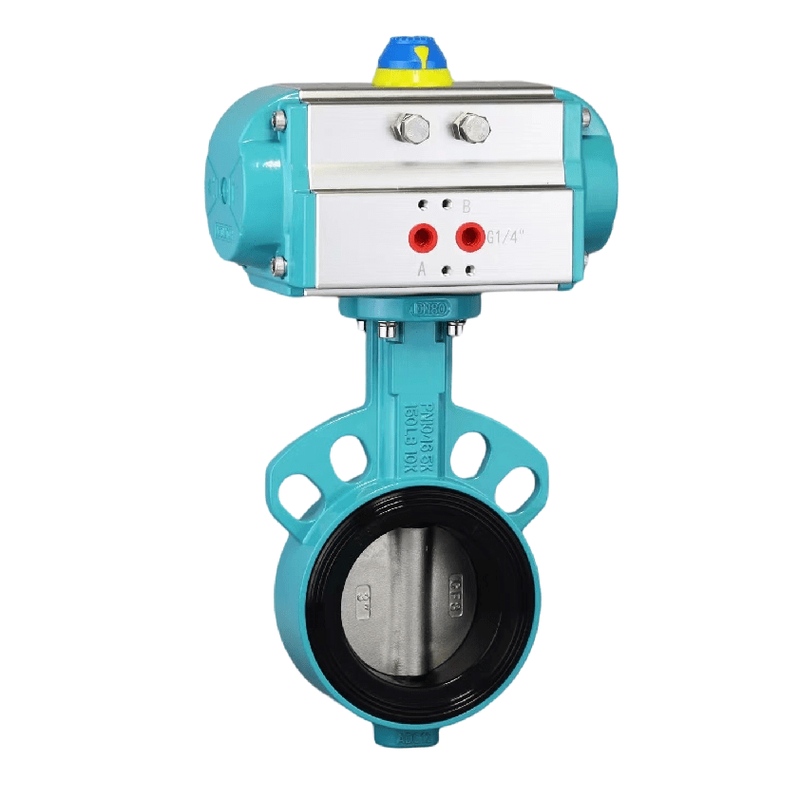
Pneumatic Aluminum Alloy Clamp Butterfly Valve
The pneumatic aluminum alloy clamp butterfly valve is a lightweight wafer-type isolation valve assembled with a pneumatic actuator for automated on-off or modulating service in HVAC, compressed air distribution, water treatment, food and beverage utility lines and general industrial piping. Manufactured by Trekre & Fouten Valve at our Wuxi factory, this clamp (wafer) butterfly valve uses an aluminum alloy body for reduced weight and corrosion resistance in ambient service, a centerline disc-and-seat geometry for economical shutoff, ISO 5211 top-flange actuator mounting and a short face-to-face length that installs between pipeline flanges without integral body flanges.
Compared with cast iron or cast steel wafer butterfly valves, the aluminum alloy body lowers installed weight on overhead rack piping and rooftop HVAC headers, which simplifies support design and actuator sizing on large nominal diameters. Compared with double-flange triple-offset metal seated pneumatic valves, this clamp design stays cost-effective for moderate temperature and pressure duty where resilient or PTFE seats provide adequate sealing. The valve accepts double-acting or spring-return single-acting pneumatic actuators and can be fitted with a positioner for 4–20 mA proportional control, solenoid valves, air filter-regulators and limit switches for remote position feedback.
Structure and working principle
The valve body follows a wafer (clamp) pattern installed between two pipeline flanges and secured with through-bolts or stud bolts spanning the flanges. The disc rotates 90 degrees around a stem supported by internal bearings and a packing gland. In the centerline design the stem axis passes through the disc centerline; the disc turns in the flow bore and compresses the seat ring at full closure. The aluminum alloy body is cast or machined to provide a smooth bore, flange locating lugs and a standardized ISO 5211 mounting pad on the bonnet for direct actuator attachment.
The pneumatic actuator bolts to the ISO 5211 pad on the valve bonnet. Rack-and-pinion actuator construction is typical for this valve class: supply air at typically 3–7 bar drives the piston rack to rotate the pinion and stem. Double-acting actuators use air pressure to open and close without internal springs; they hold the last position when air supply fails unless the control system vents both ports. Single-acting spring-return actuators use air on one side and internal springs on both sides to drive the disc to a defined fail-safe position when pilot air is lost. The actuator housing is aluminum alloy with stainless steel fasteners, epoxy-coated for corrosion protection, and fitted with a visible open/closed position indicator on the top cover.
Optional accessories include electro-pneumatic positioners for modulating flow, Namur-pattern solenoid valves for DCS on-off commands, air filter-regulators to remove moisture and stabilize supply pressure, and dry-contact or proximity limit switches reporting fully open and fully closed states. After assembly with a positioner, the valve supports 4–20 mA analog adjustment of disc opening for balanced HVAC loops, chilled water branches and batch transfer headers.
Nominal size and pressure class
Standard production covers nominal diameters from DN40 to DN600 (NPS 1-1/2 to 24) in common increments for building services and process branches. Pressure ratings typically include EN PN10 and PN16 and ANSI Class 150 wafer configurations. Face-to-face dimensions follow manufacturer tables for centerline wafer butterfly valves or project-specific requirements. Connection dimensions can be supplied to United States, European, Japanese, German and other regional flange standards as specified on the purchase order. Confirm flange drilling, gasket type and bolt length before ordering companion flanges and wafer gaskets.
Body, disc and seat materials
The primary body material for this product line is aluminum alloy, selected for weight reduction and satisfactory performance in air, water and mild chemical service within the alloy temperature limit. Alternative body materials include ductile iron, cast steel WCB and stainless steel CF8 or CF8M when project specifications require higher mechanical strength or different corrosion resistance. The disc can be stainless steel 304 or 316, duplex 2507 for more aggressive brine or chloride environments, or lined disc constructions when fluoropolymer wetted surfaces are specified. Seat options include EPDM for water and HVAC, NBR for oil-bearing air, PTFE for more aggressive chemicals within the liner temperature limit, and VITON where higher temperature elastomer service is required.
Sealing form and leakage performance
Primary sealing relies on the resilient or PTFE seat ring compressed by the disc at full closure. Centerline wafer designs provide dependable shutoff for isolation duty in water, air and compatible process fluids. Closure leakage is verified by seat test per the agreed project protocol and manufacturer test procedure; state the required leakage class or test medium in the purchase specification rather than assuming a universal rating across all sizes and seat materials.
Pneumatic actuation and control options
Double-acting actuators deliver fast cycling with opening and closing strokes typically within a few seconds when plant air pressure and actuator sizing match the valve torque requirement. Single-acting spring-return units provide fail-open or fail-close behavior according to spring placement and solenoid piping. A positioner receives 4–20 mA or 0–10 V signals and modulates pilot air to position the disc for flow regulation. Limit switch boxes with visual position indicators support remote monitoring without entering the valve gallery. Solenoid valves and filter-regulators should be selected for the plant air quality, voltage and area classification stated on the instrument datasheet.
Applicable working conditions and industries
This pneumatic aluminum alloy clamp butterfly valve is specified on potable and process water headers, chilled and hot water HVAC circuits, compressed air mains and branch lines, food and beverage utility piping where aluminum alloy wetted parts are acceptable, light chemical transfer, irrigation laterals and general plant utility interfaces. The wafer body suits space-constrained rack piping and skid packages where minimizing weight matters. For slurry, high particulate load or cavitation-prone service, consult Trekre & Fouten application staff on body material, seat selection and disc options before finalizing the specification.
Standards, inspection and delivery
Design and inspection commonly reference EN 593, MSS SP-67, API 609 Category A or GB/T 12238 depending on the project region. The valve body top flange complies with ISO 5211 for interchangeability with standard pneumatic actuators and drive accessories. Each valve undergoes shell pressure test and seat closure check before shipment. Material certificates, dimensional reports and functional actuator tests can be included in the QA dossier when requested. Valves are cleaned, flange-faced protected and packed for export from Wuxi. Trekre & Fouten Valve engineers can review your medium composition, temperature profile, fail-safe direction and control signal type to confirm body grade, seat selection and actuator class.
Product parameters
| Valve type | Pneumatic aluminum alloy clamp (wafer) butterfly valve |
| Structure | Centerline wafer type, clamp installation between flanges |
| Size range | DN40 – DN600 (NPS 1-1/2 – 24) |
| Pressure rating | PN10, PN16; ANSI Class 150 (as specified) |
| Body material | Aluminum alloy; ductile iron, WCB, CF8/CF8M optional |
| Disc material | Stainless steel 304 / 316 / 2507; lined disc optional |
| Seat material | EPDM, NBR, PTFE, VITON (as specified) |
| Operation | Pneumatic actuator, double acting or single acting spring-return |
| Top flange | ISO 5211 actuator mounting |
| Actuator | Aluminum alloy rack-and-pinion; epoxy coated; position indicator |
| Air supply | Typically 3–7 bar; stroke time commonly within a few seconds |
| Accessories | Positioner, solenoid valve, filter-regulator, limit switch |
| Control signal | On-off via solenoid; 4–20 mA via positioner |
| Design standard | EN 593, MSS SP-67, API 609, GB/T 12238 (as agreed) |
| Test | Shell and seat test per project specification |
Selection notes
Specify flange standard and pressure class, body and seat material, operating temperature and medium composition, required fail-safe direction (air to open / spring close or reverse), and whether modulating control or simple on-off duty is needed. State control voltage and area classification for solenoid and switch accessories. Confirm available plant air pressure and quality; specify air treatment if supply contains moisture or particulates. Allow clearance for actuator height and maintenance access to the solenoid and filter-regulator station. When aluminum alloy body is specified, verify compatibility with the fluid, cleaning agents and maximum operating temperature on the datasheet.
Installation and maintenance guidance
Install the wafer valve between flanges with gaskets suited to the medium and flange class. Align piping to avoid stem side load. Tighten flange bolts evenly in a cross pattern. Mount the actuator within orientation limits on the nameplate. Connect air supply through a filter-regulator and verify spring-return action with pilot air vented before putting the control circuit live. Exercise the valve through several cycles during commissioning and confirm limit switch feedback matches physical position. Periodically inspect seat contact and stem packing; replace packing when external leakage appears during thermal cycling. Check actuator epoxy coating and fastener integrity in outdoor or humid environments.
Comparison with adjacent designs
Stainless steel lug-type pneumatic butterfly valves allow downstream flange removal for maintenance but require longer bolt sets on each side and add weight compared with aluminum alloy wafer bodies. High performance double-eccentric wafer valves improve seat life under frequent modulating stroke but carry higher cost than centerline aluminum alloy clamp valves for simple water and air shutoff. Double-flange triple-offset metal seated pneumatic valves address high-temperature steam where elastomer seats would not remain stable. Electric actuators replace pneumatic drives when compressed air is unavailable, though stroke times are typically longer than pneumatic packages on the same valve size. The pneumatic aluminum alloy clamp butterfly valve fits utility branches where light body weight, ISO 5211 actuator interchangeability and compact wafer installation are all required.
This pneumatic aluminum alloy clamp butterfly valve extends the Trekre & Fouten pneumatic butterfly valve range for plant owners who need automated isolation or proportional control on HVAC, air and water utility lines with a weight-efficient aluminum alloy body. Contact our sales team with flange details, medium data, fail-safe preference and control signal requirements for quotation and delivery schedule from our China valve manufacturing facility.