
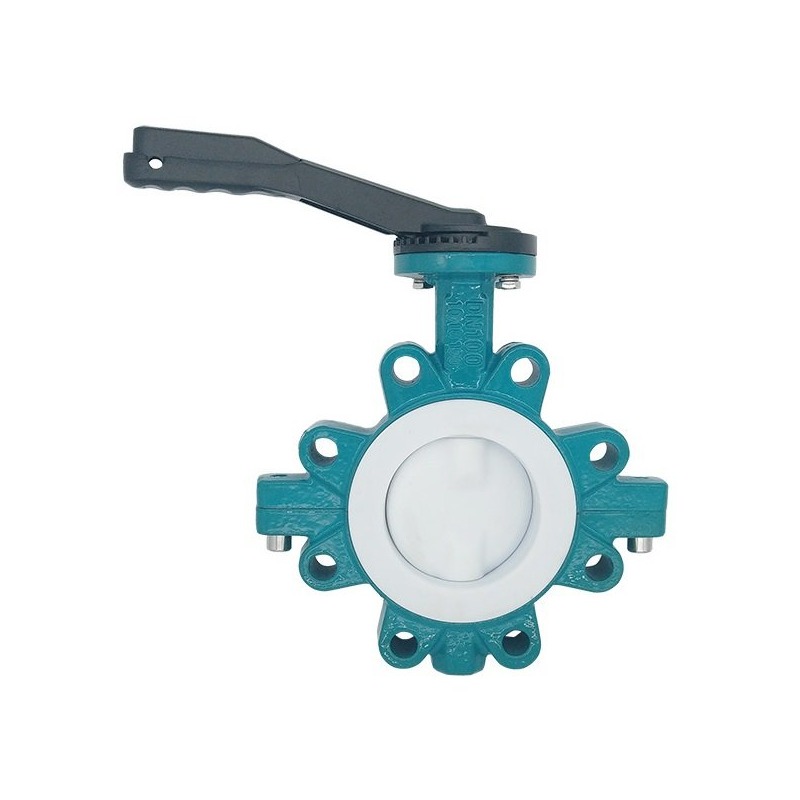

The semi-lined fluorine lug butterfly valve with handle operation is a quarter-turn isolation valve for pipelines carrying acids, alkalis, chlorine compounds, solvent blends, and other corrosive fluids. Trekre Valve builds this two-piece lug body design with PTFE, FEP, or PFA wetted linings while allowing a stainless steel disc option in semi-lined configuration for applications that need a metal sealing edge. Handle operation suits local on-off duty on chemical dosing headers, tank farm transfer lines, utility manifolds, and skid packages where automation is not required.
Table of Contents
Two-piece lug construction
The valve uses a split two-piece lug body so the seat and body bore can be lined as an integrated plastic envelope. In the semi-lined configuration, the lined body passage and seat, together with the unlined disc, contact the medium while the lug inserts provide bolt-up points between mating flanges. Lug connections alone do not establish permission for end-of-line service or downstream flange removal. Confirm the model-specific rating, installation instructions and approved isolation procedure before maintenance. The disc rotates on a stem supported by bushing and packing arrangements sized for lined butterfly valves. Four-stage sealing geometry on many fluorine lined lug designs combines fluoropolymer seat contact with elastomer backup gaskets to limit weepage at the body joints.
Lug bodies are commonly supplied in WCB carbon steel or CF8/CF8M stainless steel castings, with lining applied to all wetted passages including the disc faces when specified as fully lined. Semi-lined versions leave the disc unlined while the body bore and seat remain fluoropolymer covered. Specify the required lining coverage and verify compatibility of the exposed disc material with the actual medium.
Full-lined and semi-lined options
In the fully lined configuration, the flow passage and wetted disc surfaces are lined. Specify the required configuration and lining material when ordering, and confirm compatibility with the actual medium and operating conditions.
Semi-lined configuration leaves the disc unlined in SUS304 or SUS316 while the body and seat remain PTFE, FEP, or PFA lined. Operators choose semi-lined designs when they want the rigidity of a stainless disc for repeated cycling, or when the process contains soft solids that could embed in a fully plastic disc edge. Confirm chemical compatibility for any exposed metal with the project engineer before ordering.
Fluoropolymer lining grades
PTFE lining offers broad chemical resistance and is suitable for many acid and solvent duties within its temperature envelope. FEP lining provides a smoother molded surface and is often selected for clarity and uniform thickness on smaller bore valves. PFA lining supports higher continuous temperature than FEP on many recipes and is common where elevated acid temperatures or steam-out cycles occur. Trekre Valve marks the ordered lining grade on the nameplate and packing list; do not interchange grades without revising the corrosion review.
Handle operation and torque
A lever handle provides direct manual quarter-turn operation for nominal sizes typically up to DN150, depending on differential pressure and lining type. The handle locks the disc in open or closed positions with a detent or stop plate arrangement. Breakaway torque rises with line pressure and with PTFE cold flow over time, so verify the actual shut-off pressure during commissioning. For larger nominal sizes or high differential pressure, a worm gear operator can replace the handle while keeping the same semi-lined lug body; this product page focuses on the hand-lever package for local isolation.
Lug connection and installation
Install the semi-lined fluorine lug butterfly valve between companion flanges with the disc slightly open to avoid pinching the lining during bolt tightening. Use full-face or raised-face gaskets compatible with lined equipment; do not over-torque one side of a lug pattern, which can distort inserts and leak at the seat. Align pipe ends so the valve body is not used as a pipe support. After hydrostatic testing of the pipeline, flush debris and abrasive residues before introducing corrosive chemicals so the fluoropolymer surfaces are not scratched.
Lug patterns allow maintenance crews to remove downstream piping while leaving the valve bolted to the upstream flange, which is useful on filter skids and batch reactor outlets in chemical plants.
Size, pressure, and materials
Nominal sizes follow common chemical industry ranges from DN50 through DN600 with pressure classes such as PN10, PN16, and Class 150 when the body rating and temperature allow. Face-to-face dimensions reference ISO 5752 or API 609 category conventions depending on the order specification. Leakage performance is verified per the customer test protocol and seat design; state the required test standard on the inquiry.
| Item | Typical range |
|---|---|
| Nominal size | DN50–DN600 (NPS 2–24) |
| Pressure class | PN10, PN16, Class 150 (temperature dependent) |
| Body material | WCB, CF8, CF8M |
| Lining | PTFE, FEP, PFA on wetted surfaces |
| Disc option | Fully lined or semi-lined SS304/SS316 disc |
| Operation | Handle lever (manual quarter-turn) |
| Connection | Lug type between flanges |
Typical applications
Chemical processing plants use semi-lined fluorine lug butterfly valves on acid transfer headers, caustic circulation loops, and solvent loading stations where manual isolation is acceptable. Pharmaceutical and fine chemical sites specify PFA lining on wetted parts for high-purity acid service. Water treatment facilities deploy PTFE lined lug valves on sodium hypochlorite and alum dosing lines. Petrochemical utilities select semi-lined discs when occasional abrasive carryover is expected in drain systems, provided the metal disc remains compatible with the fluid.
Maintenance and service notes
Operate the valve through a full cycle on a schedule that matches plant turnover requirements. Inspect the handle connection, stem packing area, and flange bolting during outages. Do not use the valve to throttle highly corrosive fluids unless the datasheet confirms throttling duty; most lined lug valves are intended for on-off service. Store spare valves with the disc open and bore protected from UV and contamination. If the lining is damaged by mechanical impact, replace or reline the valve—field patching is not equivalent to factory lining.
Ordering and documentation
Provide medium composition, design temperature, design pressure, nominal size, flange standard, lining grade (PTFE, FEP, or PFA), full-lined or semi-lined disc selection, handle orientation, and required inspection documents. Trekre Valve, as a China valve manufacturer, can supply material certificates, hydrostatic test records, and dimensional reports aligned with the purchase order. Final dimensions, torque, and leakage class remain per the approved drawing and test report for the specific tag number.
Selection questions
When should I choose semi-lined instead of fully lined? Choose semi-lined when a stainless disc edge is acceptable to the corrosion review and may improve cycling on fluids with minor solids. Fully lined remains the conservative choice for pure acid service.
Can this valve be used for throttling? Use it primarily for isolation unless the project datasheet explicitly rates throttling duty for the selected size and lining.
What actuator options exist beyond the handle? The same lug body accepts worm gear, pneumatic, or electric operators on an ISO 5211 top flange when automation is added later.
For related products, compare the PTFE lined pneumatic lug butterfly valve and the fluorine lined lug butterfly valve PFA FEP PTFE listings elsewhere in the Trekre butterfly valve category. Contact Trekre Valve for semi-lined fluorine lug butterfly valve quotations with lining grade confirmation and test requirements.