

Wafer and flanged check valves are often compared by installation length, weight and purchase cost. However, the connection style alone does not determine which check valve is better. Internal construction, cracking pressure, pressure loss, reverse-flow response and pipeline transients are essential to proper selection.
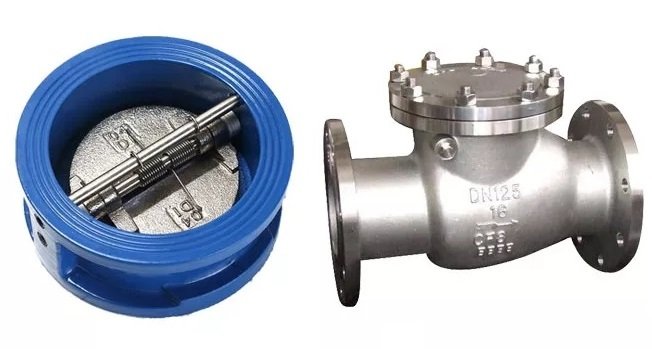
Connection type is not the same as valve mechanism
A wafer check valve is installed between mating pipeline flanges. A flanged check valve has integral flanged ends connected to the piping. Both connection arrangements can be associated with different internal closing mechanisms, depending on the product design.
Swing check valves normally use a hinged disc. Dual-plate designs generally use two spring-assisted plates. Lift or axial check valves use a moving closing member guided along a travel path. These mechanisms can behave differently even when their nominal pressure class and connection style are similar.
Wafer and flanged check valve comparison
| Selection factor | Wafer connection | Flanged connection |
|---|---|---|
| Pipeline connection | Body clamped between mating flanges | Integral valve flanges connect to mating pipe flanges |
| Face-to-face dimension | Often compact, depending on standard and design | Depends on valve design and applicable face-to-face standard |
| Internal closing mechanism | May use dual plates, a disc or another approved design | May use swing, lift or another approved design |
| Cracking pressure | Determined by spring, disc, orientation and flow conditions | Determined by closing member, weight, spring and orientation |
| Pressure loss | Requires model-specific Cv/Kv or flow-loss data | Requires model-specific Cv/Kv or flow-loss data |
| Water hammer response | Depends on closure dynamics and reverse-flow velocity | Depends on closure dynamics and reverse-flow velocity |
| Pressure rating | Follows the actual valve construction and specified rating | Follows the actual valve construction and specified rating |
What determines water hammer performance?
Water hammer can occur when fluid velocity changes rapidly and a pressure wave travels through the pipeline. In a check-valve installation, the flow deceleration rate, pump shutdown sequence, pipe characteristics and the valve’s closure response influence the resulting transient pressure.
A spring-assisted short-stroke design may close differently from a conventional swing check valve, but neither wafer construction nor flanged construction alone proves faster closure or lower surge pressure. For demanding pump-discharge applications, evaluate the selected check valve with relevant dynamic data and a system transient analysis.
Cracking pressure and operating flow
Cracking pressure is the differential pressure at which a check valve begins to open. It varies with spring loading, gravity, disc orientation, fluid properties and the actual design. The valve must also open sufficiently during normal flow without unstable flutter or excessive pressure loss.
An oversized check valve can operate with an incompletely opened disc at low flow, potentially increasing wear and instability. The selected nominal size and mechanism should therefore reflect the operating flow range rather than pipe diameter alone.
Installation and maintenance considerations
Check the approved flow direction, allowable installation orientation, pipe supports, gasket arrangement and the available clearance for servicing. Wafer connections require compatible companion flanges and the specified fasteners. Flanged designs require the applicable flange dimensions, facing and bolting.
Some check valves are suitable for vertical upward flow; others have additional orientation restrictions. A claim that every wafer or every flanged check valve may be installed horizontally or vertically is not reliable without the model’s installation instructions.
How to choose the appropriate check valve
- Identify the medium, operating temperature and design pressure.
- Record the normal, minimum and maximum flow rates.
- Specify the connection, pressure class and face-to-face constraints.
- Choose an internal mechanism suitable for the operating flow and transient behavior.
- Review cracking pressure, pressure drop and available dynamic closure data.
- Verify the permitted installation orientation and maintenance requirements.
Compare the available check valves, wafer check valves and swing check valves before selecting a specific construction.
Frequently Asked Questions
Should I choose a wafer or flanged check valve for my pipeline?
Compare the required connection and face-to-face space with the actual internal closing mechanism, pressure rating, operating flow range and maintenance access. Neither connection style is automatically the better choice or inherently rated for higher pressure. Use model-specific data for the selected valve.
Which check valve should I specify if water hammer is a concern?
Evaluate the valve closure dynamics together with flow deceleration, pump shutdown and the pipeline system. Request relevant dynamic data and, for demanding pump-discharge service, a system transient analysis. A wafer connection or flanged connection alone does not establish surge performance.
Can the check valve be installed in my vertical pipeline?
Confirm the permitted orientation and flow direction in the selected model’s installation instructions. Some designs permit vertical upward flow, while others have additional restrictions. Do not approve the installation based on connection style alone.