

The principle of pneumatic ball valve?The working principle of the pneumatic ball valve is to make the valve flow or block by rotating the valve core. The pneumatic ball valve is easy to switch and small in size. The ball valve body can be integral or combined. Pneumatic ball valves are mainly divided into pneumatic ball valves, pneumatic three-way ball valves, pneumatic shut-off ball valves, pneumatic fluorine-lined ball valves and other products. It can be made into a large diameter, with good sealing, simple structure, and convenient maintenance. The sealing surface and spherical surface are often in a closed state, which is not easy to be eroded by the medium, and has been applied in many industries.
Principle of pneumatic ball valve structure
The pneumatic ball valve itself has a compact structure and is easy to operate and maintain. Suitability for water, solvents, acids, natural gas or other media depends on the selected valve’s wetted materials, seals and operating conditions. Oxygen, hydrogen peroxide and other special services require documented material compatibility, cleanliness and an approved service-specific configuration. The ball valve body can be integral or combined.
principle of pneumatic ball valve
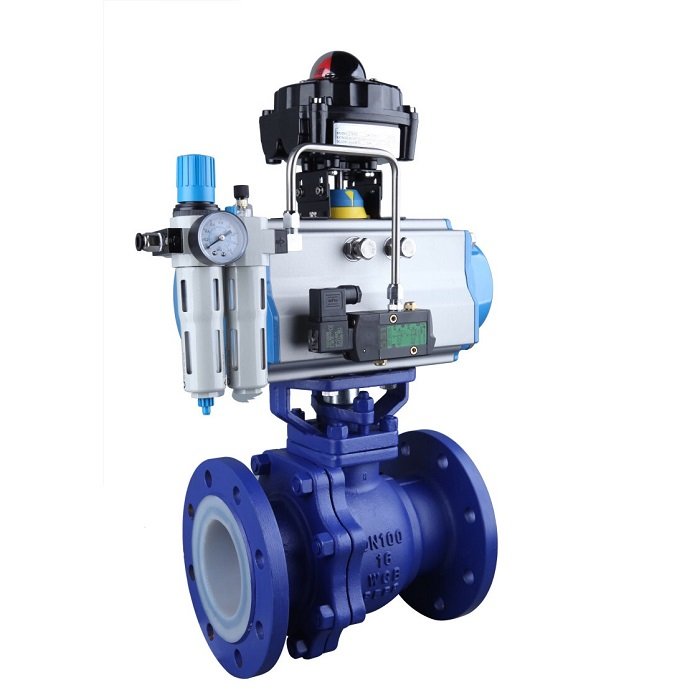
Advantages of pneumatic ball valve
Pneumatic ball valve and plug valve belong to the same type of valve, only its closing part is a sphere, and the sphere rotates around the centerline of the valve body to achieve opening and closing.principle of pneumatic ball valve
Pneumatic ball valves are used to open or shut off flow. Diverting or combining duties require a suitable multi-port flow configuration selected for the piping arrangement. Ball valve is a new type of valve, Advantages of pneumatic ball valve:
- Flow resistance depends on the actual port geometry, opening position and operating conditions. Use the selected valve’s documented flow coefficient or pressure-loss data rather than assuming equivalence to a straight pipe of the same length.
- Simple structure, small size and light weight.
- Good sealing performance. Plastic is widely used as the sealing surface material of ball valves, which has good sealing performance and has been widely used in vacuum systems.
- It is easy to operate, fast to open and close, and rotates 90° from fully open to fully closed, which is convenient for long-distance control.
- Easy maintenance, the structure of the pneumatic ball valve is simple, the sealing ring is generally movable, and it is more convenient to disassemble and replace.
- The position and exposure of the ball and seat depend on the valve design and opening position. Do not assume that either end position prevents erosion; review the actual medium, solids content, velocity and operating duty when selecting the seat and trim.
- The scope of application is wide, the diameter is as small as a few millimeters, as large as several meters, and it can be applied from high vacuum to high pressure.
- Because the power source of the ball valve is gas, the pressure is generally 0.4-0.7MPa. Pneumatic actuator exhaust is separate from leakage of the process medium through the valve. Do not assume process leakage can be vented directly; hazardous media require approved isolation, containment or disposal procedures for the actual service.
- Manual, gear-operated and pneumatic drives can be used with different valve sizes. Select the operating arrangement from the actual valve torque, differential pressure, cycle duty and available operating force or air supply; the drive type alone does not impose a general DN300 size limit.
Frequently Asked Questions
What air-supply information should I provide for a pneumatic ball-valve inquiry?
Provide the available air-supply conditions at the installation and request the requirements of the selected actuator and control equipment. Do not treat the general air-pressure reference in this article as the specification for every assembly.
Will the valve move to a safe position if the air supply fails?
Specify the required failure response and ask for confirmation of the complete actuator and control arrangement. A pneumatic product description by itself does not establish a fail-open, fail-closed or hold-position function.
Can I use the same pneumatic ball valve for different chemicals?
Provide each medium, concentration and operating condition and request a compatibility review of all wetted components. The application examples in this article do not mean that one body, seat and seal arrangement is suitable for every listed substance.